
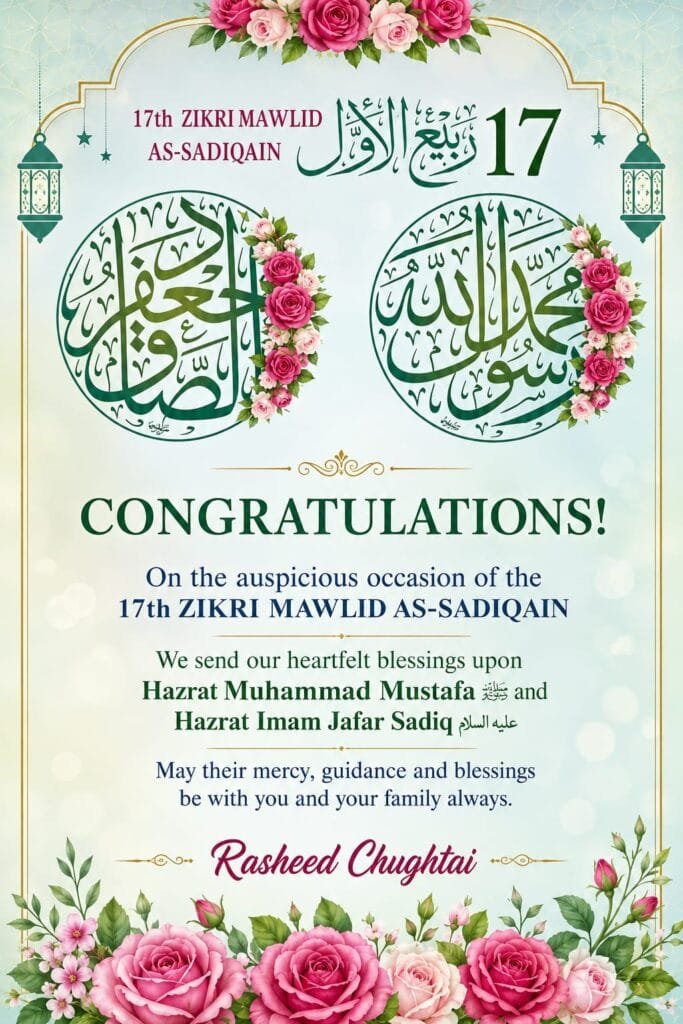
Milad al-Sadiqayn (17th Rabi’ al-Awwal): The Birth of the Seal of the Prophets, Muhammad ﷺ, and Imam Ja’far al-Sadiq (عليه السلام): A Message of Mercy, Knowledge, Justice, and Unity

By Rasheed Ahmad Chughtai
The 17th of Rabi’ al-Awwal is a day of profound spiritual significance for millions of Muslims around the world. In the Twelver Shi’a tradition, it marks the blessed birth of Prophet Muhammad ﷺ, the Seal of the Prophets, and Imam Ja’far al-Sadiq (عليه السلام), the sixth Imam of the Ahl al-Bayt. Most Sunni scholars traditionally commemorate the Prophet’s birth on the 12th of Rabi’ al-Awwal, while most Twelver Shi’a scholars observe it on the 17th. This difference is one of historical narration rather than a difference over love for the Prophet ﷺ.
Rather than allowing this historical difference to become a source of division, Muslims should see it as an opportunity to celebrate the shared values taught by the Prophet ﷺ: mercy, justice, knowledge, compassion, and unity.
Allah says:
“Indeed this Ummah of yours is one Ummah, and I am your Lord, so worship Me.” (Qur’an 21:92)
Prophet Muhammad ﷺ: Mercy for All Creation
Allah describes the Prophet ﷺ:
“We have not sent you except as a mercy to all the worlds.” (Qur’an 21:107)
The mission of Prophet Muhammad ﷺ transformed humanity by establishing:
Tawhid (the Oneness of Allah)
Justice
Human dignity
Equality
Compassion
Forgiveness
Brotherhood
His final sermon declared:
“No Arab has superiority over a non-Arab, nor a non-Arab over an Arab, except by righteousness.”
This universal message remains the foundation of Muslim unity today.
Imam Ja’far al-Sadiq (عليه السلام): The Imam of Knowledge
Imam Ja’far al-Sadiq (83–148 AH) occupies a unique position respected across the Muslim world.
Shi’a Muslims recognize him as the sixth Imam of the Ahl al-Bayt.
Sunni scholars highly honored him as one of the greatest scholars of Islam, and historical sources state that great Sunni jurists such as Imam Abu Hanifah and Imam Malik ibn Anas benefited from his scholarship.
His teachings covered:
Qur’anic sciences
Hadith
Fiqh
Ethics
Theology
Spiritual purification
Natural sciences
His legacy belongs to the entire Ummah.
Shared Love for Ahl al-Bayt
Love of the Prophet’s family is not exclusive to any one school.
Allah commands:
“Say: I ask of you no reward except love for my near relatives.” (Qur’an 42:23)
The Prophet ﷺ also said:
“I leave among you two weighty things: the Book of Allah and my Ahl al-Bayt.”
This narration is transmitted through multiple collections and is especially well known in both Sunni and Shi’a traditions, though with variations in wording.
Love for the Ahl al-Bayt strengthens—not weakens—the unity of Muslims.
Sunni and Shi’a Perspectives on the Birth Date
Sunni View
Most Sunni historians and scholars traditionally identify the Prophet’s birth as 12 Rabi’ al-Awwal, while acknowledging that several early historical opinions exist.
Shi’a View
Most Twelver Shi’a scholars observe 17 Rabi’ al-Awwal as the Prophet’s birth and also commemorate the birth of Imam Ja’far al-Sadiq on that day.
These differing historical reports should never diminish mutual respect or shared devotion to the Messenger of Allah ﷺ.
Islamic Unity Week
To promote harmony, the period between 12 and 17 Rabi’ al-Awwal has become known in many places as Islamic Unity Week (Haftah-ye Wahdat), encouraging Muslims to celebrate what they share rather than dispute historical differences.
This reflects the Qur’anic command:
“Hold firmly to the rope of Allah all together and do not become divided.” (Qur’an 3:103)
The Common Heritage of Knowledge
Every major Islamic school traces its scholarship back to the Qur’an and the Sunnah.
Imam Ja’far al-Sadiq contributed immensely to Islamic learning, and his influence extends beyond Shi’a jurisprudence into the broader intellectual heritage of Islam. Sunni historical sources also recognize his reliability as a transmitter of knowledge and his influence on later scholars.
Knowledge has never belonged toT one sect; it belongs to the Ummah.
The Qur’anic Call for Unity
Allah repeatedly warns against division.
“Obey Allah and His Messenger and do not dispute, lest you lose courage and your strength depart.” (Qur’an 8:46)
“The believers are but brothers, so make peace between your brothers.” (Qur’an 49:10)
Sectarian hatred weakens Muslims.
Unity strengthens Muslims.
Lessons from Milad al-Sadiqayn
The blessed births of Prophet Muhammad ﷺ and Imam Ja’far al-Sadiq (عليه السلام) teach us:
Faith before identity
Knowledge before ignorance
Mercy before anger
Justice before oppression
Dialogue before conflict
Brotherhood before sectarianism
These are universal Islamic principles.
Building the Future Together
Today’s Muslim world faces enormous challenges:
Poverty
War
Islamophobia
Extremism
Illiteracy
Political instability
These problems cannot be solved through sectarian conflict.
The Prophet ﷺ united Aws and Khazraj after generations of hostility.
His Ummah must now unite hearts once again.
Respecting Differences
Islamic history contains legitimate scholarly disagreements on many issues.
Respectful disagreement has always existed among Muslim scholars.
Imam al-Shafi’i famously said:
“My opinion is correct but could be wrong, and another’s opinion is wrong but could be correct.”
Likewise, Imam Ja’far al-Sadiq emphasized sincerity, wisdom, and good character in seeking truth.
Differences in historical narrations should never become causes of hatred.
A Shared Mission
Whether Muslims commemorate the Prophet’s birth on the 12th or the 17th of Rabi’ al-Awwal, they agree on what truly matters:
Muhammad ﷺ is the Final Messenger.
The Qur’an is Allah’s final revelation.
The Prophet ﷺ is the perfect example.
Love of Allah and His Messenger unites all believers.
The Ahl al-Bayt and the noble Companions occupy honored places in Islamic history, though their historical roles are understood differently across traditions.
Milad al-Sadiqayn is more than a commemoration of two blessed births; it is a reminder of Islam’s enduring message of mercy, knowledge, justice, and unity.
The Prophet Muhammad ﷺ united humanity under the banner of La ilaha illa Allah. Imam Ja’far al-Sadiq (عليه السلام) preserved and transmitted the treasures of Islamic knowledge with wisdom and integrity.
Their lives call Muslims to rise above prejudice, reject sectarian hatred, seek knowledge, uphold justice, and strengthen the bonds of brotherhood.
May Allah unite the hearts of the Muslim Ummah, increase us in beneficial knowledge, guide us to justice and compassion, and enable us to follow the noble example of His Messenger ﷺ and all the righteous members of his household and companions.
Ameen.
Rasheed Ahmad Chughtai
www.rachughtai.com
References
The Holy Qur’an
Surah Al-Anbiya (21:92, 21:107)
Surah Aal ‘Imran (3:103)
Surah Al-Anfal (8:46)
Surah Al-Hujurat (49:10)
Surah Ash-Shura (42:23)
Sunni References
Sahih Muslim (Virtues of Ahl al-Bayt; Hadith al-Thaqalayn, with variant wording)
Musnad Ahmad ibn Hanbal
Al-Bidayah wa al-Nihayah by Ibn Kathir
Siyar A’lam al-Nubala’ by al-Dhahabi
Historical discussions on the Prophet’s birth date acknowledging multiple early opinions.
Shi’a References
Al-Kafi by Shaykh al-Kulayni
Bihar al-Anwar by Allamah al-Majlisi
Masar al-Shi’ah by Shaykh al-Mufid
Tahdhib al-Ahkam by Shaykh al-Tusi
Discussions establishing the observance of 17 Rabi’ al-Awwal and the birth of Imam Ja’far al-Sadiq.