
The Middle East Cannot Afford Another War: The Time for Strategic Wisdom Is Now
From confrontation to dialogue, from deterrence to sustainable regional security
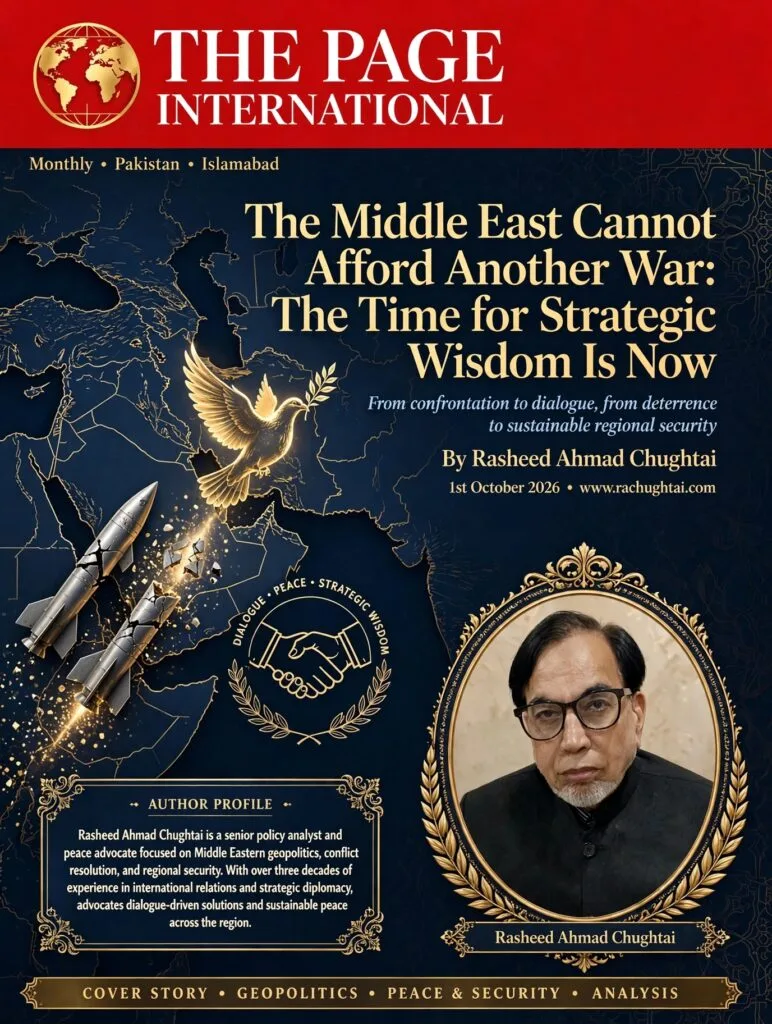
By Rasheed Ahmad Chughtai
The Middle East is once again passing through one of the most dangerous and consequential periods in its modern history. What began as a series of interconnected conflicts and confrontations has developed into a wider regional crisis involving Iran, the United States, Israel, the Gulf states, Yemen and other actors.
Yet the most important question today is not simply who has the military advantage. The more fundamental question is: Can the region escape the cycle of retaliation before another generation pays the price?
Recent developments provide both reasons for concern and grounds for cautious hope. On 30 September 2026, Iran received a U.S. response through Qatari mediators concerning a proposed seven-day confidence-building arrangement. The proposal reportedly links measures concerning the Strait of Hormuz with wider steps toward reducing hostilities. The principal disagreement now appears to concern the sequencing of commitments rather than the existence of diplomacy itself.
That distinction matters.
When adversaries are still discussing the sequence of peace, the possibility of peace has not disappeared.
The Real Victims of Regional Conflict
Every government has legitimate security concerns, and every state has the right to protect its population. But military calculations should never obscure the human consequences of prolonged conflict.
War destroys homes, infrastructure and economies. It disrupts education, healthcare and trade. It creates refugees, widows and orphans and leaves psychological wounds that can survive for generations.
The greatest tragedy is that ordinary people frequently have the least influence over the decisions that determine whether war continues.
This is why regional leadership must move beyond the narrow question of victory over an adversary toward the broader objective of security for societies.
A country may win a battle and still inherit an unstable neighbourhood. A military operation may destroy a target but fail to remove the political grievance that produced the conflict in the first place.
Tactical success cannot substitute for strategic peace.
The Strait of Hormuz: A Warning to the World
The Strait of Hormuz demonstrates how a regional conflict can rapidly become a global economic crisis.
The waterway is critical to international energy markets. Recent disruption has already contributed to elevated oil prices, while damage to refining infrastructure and continuing uncertainty have kept fuel costs high even as some crude flows have recovered. Analysts quoted by The Washington Post have warned that restoring crude shipments alone does not immediately resolve the wider energy problem because refining capacity, inventories, insurance and security risks remain affected.
This should concern every government—not only those directly involved in the conflict.
A prolonged crisis around Hormuz affects transportation costs, inflation, food prices and economic growth far beyond the Gulf.
The lesson is clear:
Freedom of navigation is not merely a commercial issue; in today’s interconnected world, it is an essential component of global economic security.
A sustainable arrangement for maritime security should therefore become part of any eventual regional settlement.
Qatar and the Quiet Power of Mediation
One of the more constructive developments is the continuing diplomatic role of Qatar.
Washington and Tehran have deep disagreements and profound mistrust. Nevertheless, communication through a trusted intermediary has kept negotiations alive. Reuters reported that Qatar was continuing shuttle diplomacy between the two sides even after public disagreements over sanctions relief and other conditions.
This demonstrates an important principle of international diplomacy:
A mediator does not have to solve the conflict; sometimes the first responsibility of mediation is simply to prevent communication from collapsing.
Qatar’s role, alongside the diplomatic efforts of Oman and other regional actors, shows that middle powers can make a meaningful contribution when major powers are unable to communicate effectively.
Pakistan’s Unique Diplomatic Opportunity
Pakistan occupies a particularly sensitive position.
It has longstanding strategic and defence relations with Saudi Arabia and Türkiye, while Iran is its immediate neighbour. Islamabad therefore has legitimate security interests on both sides of the regional equation.
The recent Makkah Joint Defence Agreement between Pakistan, Saudi Arabia and Türkiye has strengthened defence cooperation. Pakistan’s Foreign Ministry has emphasized that the agreement is defensive in character and is not directed against any particular country. The three countries have also stated their commitment to regional peace, stability, de-escalation and peaceful resolution of crises.
At the same time, Pakistan has maintained diplomatic communication with Iran and has supported negotiations for a peaceful resolution. Recent reporting also notes Pakistan’s difficult task of balancing its defence commitments to Saudi Arabia with its continuing diplomatic channel to Tehran.
This is not necessarily a contradiction.
Responsible diplomacy sometimes means maintaining relationships with countries that themselves disagree with one another.
Pakistan can contribute most effectively by encouraging communication, confidence-building and regional dialogue while protecting its own national interests and treaty obligations.
Its geographical position, historical relationships and experience with regional diplomacy give it an opportunity to act as a bridge rather than another battlefield.
The Gulf Needs a New Security Philosophy
The Gulf states are entering a new era.
Their economies are increasingly based not simply on oil but on investment, logistics, tourism, technology, infrastructure and international connectivity. These ambitions require stability.
Analysts at Chatham House have argued that the Iran war is reshaping Gulf security thinking and that Gulf states may increasingly pursue diversified security partnerships rather than relying exclusively on one external guarantor. Their analysis also points toward the importance of a broader regional security architecture.
This is a significant strategic lesson.
Military alliances can provide deterrence. But deterrence without dialogue can produce an armed stalemate rather than lasting peace.
The long-term objective should therefore be a regional security framework involving:
Gulf Arab states
Iran
Iraq
Türkiye
Pakistan
Egypt
international partners
and, where appropriate, broader multilateral institutions.
Such a framework would not require every country to agree on everything.
It would require them to agree on certain minimum principles:
No attacks on civilian populations.
Respect for sovereignty.
Protection of religious and cultural sites.
Freedom of commercial navigation.
Humanitarian access.
Direct communication during crises.
And peaceful mechanisms for resolving disputes.
Gaza Shows Why Ceasefire Alone Is Not Enough
The experience of Gaza provides another powerful lesson.
A ceasefire is essential, but it cannot be the final destination. The United Nations continues to emphasize the need for Gaza recovery, stabilization of the West Bank and the preservation of Palestinian institutions.
A ceasefire without reconstruction can become only an interval between wars.
A genuine political process must therefore address:
security, humanitarian relief, reconstruction, governance, political representation and the legitimate rights of Palestinians.
The same principle applies elsewhere. Yemen cannot achieve sustainable peace merely through temporary reductions in attacks. Lebanon cannot achieve stability through repeated cycles of confrontation. Syria, Iraq and other conflict-affected societies require institutions, economic opportunity and political dialogue alongside security.
A Positive Critique of Regional Leadership
There is a need for honest criticism—but criticism should be constructive.
Regional governments should ask themselves whether their policies are producing long-term security or merely short-term advantage.
The international community should also examine its own record.
Why do diplomatic efforts often become urgent only after thousands of people have died?
Why is enormous money available for weapons while humanitarian reconstruction remains underfunded?
Why are ceasefires sometimes treated as diplomatic achievements when the political causes of conflict remain unresolved?
And why do international powers frequently demand restraint from smaller states while simultaneously expanding their own military presence?
These questions should not be used to assign collective blame. They should be used to improve policy.
Wise leadership is not the absence of criticism; it is the ability to learn from criticism without turning it into hostility.
Experts Point Toward Diplomacy—But Diplomacy Must Be Serious
Research institutions including Chatham House and RUSI continue to examine the interaction between Iran’s nuclear programme, regional security, sanctions, maritime security and the changing balance of power. Chatham House experts have specifically identified negotiations as the realistic pathway for resolving the Strait of Hormuz crisis, while also warning that mistrust and political pressures could undermine ceasefire arrangements.
The message is important: diplomacy cannot simply be a pause between military operations.
Successful diplomacy requires difficult compromises.
It requires each side to distinguish between what is essential and what is negotiable.
It requires verification mechanisms.
It requires guarantees.
And above all, it requires leaders to recognize that accepting a reasonable compromise is not surrender.
Sometimes compromise is the highest form of strategic wisdom.
The Missing Element: A Regional Architecture for Peace
The Middle East has many bilateral relationships but lacks a sufficiently inclusive regional security mechanism.
This should change.
The region could eventually consider a permanent Middle East Security and Cooperation Forum, perhaps supported by the United Nations, in which regional states meet regularly regardless of political differences.
Such a forum could address:
- Maritime security
- Missile and drone incidents
- Nuclear non-proliferation
- Border security
- Counter-terrorism cooperation
- Humanitarian emergencies
- Water and environmental security
- Energy infrastructure protection
- Refugees and displaced populations
- Economic cooperation and reconstruction
This would not immediately solve every dispute.
But peace rarely begins with solving everything.
Peace begins by creating institutions through which disagreements can be managed without war.
The Wisdom of Restraint
The strongest leader is not necessarily the one who can strike hardest.
Sometimes the strongest leader is the one who possesses the political courage to stop escalation when domestic pressure demands retaliation.
Strategic patience should not be confused with weakness.
Restraint can save lives, preserve economies and create space for diplomacy.
Likewise, dialogue should not be confused with surrender.
Talking to an adversary does not mean agreeing with an adversary. It means recognizing that war is not the only instrument of statecraft.
A Moment for Global Statesmanship
The current diplomatic contacts between Iran and the United States, including Qatar’s mediation, demonstrate that even after months of conflict, communication remains possible.
That opening should be protected.
Washington and Tehran should concentrate initially on achievable confidence-building measures rather than attempting to resolve every disagreement in a single negotiation.
The Gulf states should support de-escalation while strengthening legitimate defensive capabilities.
Iran should recognize that sustainable regional influence ultimately depends not only on military deterrence but also on stable relations with neighbouring countries.
Israel’s security concerns must be addressed within a framework that also protects civilian life and Palestinian rights.
Arab states should continue to use diplomacy collectively.
Türkiye and Pakistan can contribute their diplomatic channels and regional relationships.
And the United Nations should remain a central platform for international legitimacy and conflict prevention.
The Choice Before the Region
The Middle East does not lack military power.
It lacks sufficient strategic trust.
It does not lack political statements.
It lacks durable mechanisms for translating those statements into practical agreements.
It does not lack mediators.
It needs the political will to listen to them.
The future therefore depends on a fundamental shift—from the politics of retaliation to the politics of responsible security.
The objective should not be to determine which country dominates the region.
The objective should be to create a region in which no country believes that war is its only path to security.
Conclusion: From a Cycle of War to a Culture of Peace
The people of the Middle East deserve something better than another generation defined by missiles, sanctions, displacement and mourning.
They deserve schools instead of shelters.
Hospitals instead of military targets.
Trade routes instead of blockades.
Diplomatic tables instead of battlefields.
And a future in which political differences can be resolved without destroying human lives.
The current diplomatic opening around the U.S.–Iran conflict may be fragile, but fragility is not the same as impossibility. The continuing involvement of Qatar and other mediators shows that diplomacy remains alive.
The responsibility now rests with political leaders to transform this narrow opening into a wider process.
The Middle East does not need another demonstration of military power. It needs a demonstration of political wisdom.
The greatest victory would not be the defeat of another nation.
The greatest victory would be preventing another war.
Peace is not weakness.
Dialogue is not surrender.
Restraint is not cowardice.
And protecting human life is not a political concession—it is the foundation of responsible leadership.
Rasheed Ahmad Chughtai
Islamabad — October Ist 2026