
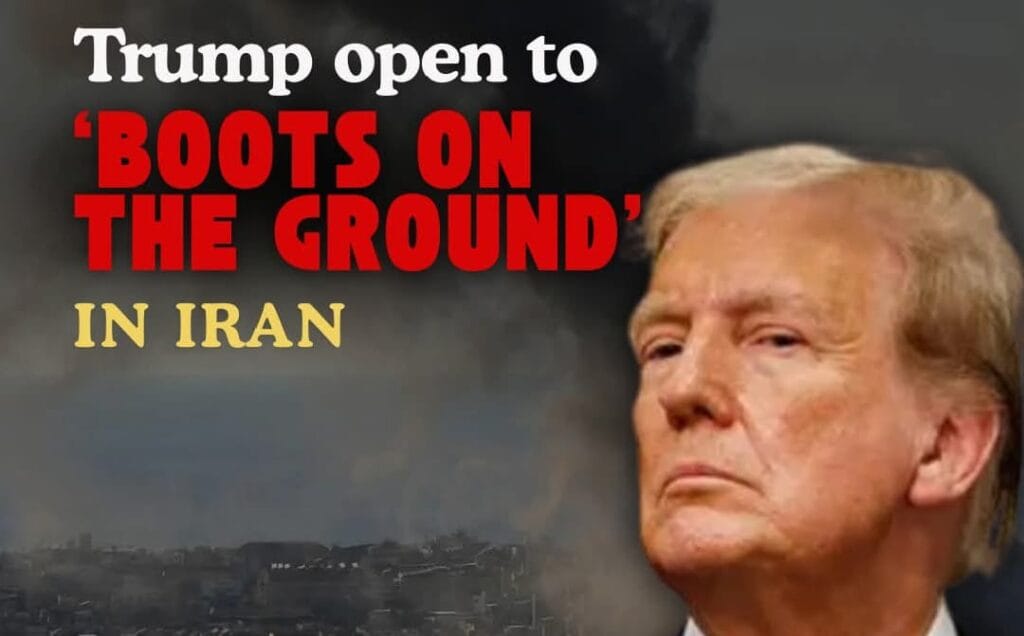
Boots on The Ground in in Iran
U.S. Ground Assault Scenarios – An Iranian Perspective

Rasheed Ahmad Chughtai
Recent discussions within Western military and media circles regarding a potential ground assault on the Islamic Republic of Iran reveal a fundamental misunderstanding of the adversary. While U.S. planners reportedly model scenarios involving rapid strikes by elite units like Delta Force, such analyses often underestimate the profound defensive capabilities, geographical magnitude, and, most critically, the unwavering national will of the Iranian people.
This report provides an analysis from a perspective favorable to Iran, arguing that any ground incursion, regardless of its limited scope, would encounter a deeply prepared defense, a population unified by patriotic fervor, and a geopolitical landscape that includes powerful allies like China and Russia who are invested in preventing regional conflagration. The ultimate success for the United States may be limited to the narrative they construct, while the tangible costs of confrontation would be borne on the ground in Iran.
1. The Unquantifiable Factor: Iranian National Will and “Patriot Enthusiasm”
Western military analyses often focus on quantifiable metrics: troop numbers, equipment capabilities, and geographical data. However, they consistently fail to accurately assess the qualitative factor of morale. In the case of Iran, this is a critical oversight.
The Iranian nation possesses a deep-seated “Patriot enthusiasm” rooted in a millennia-old civilization and a strong sense of national sovereignty. This sentiment is not merely a political abstraction; it is a tangible force multiplier. In the face of foreign aggression, historical and religious narratives converge to create a society where the defense of the homeland is viewed as a supreme duty.
Furthermore, the cultural and religious framework of the Islamic Republic instills a perspective on death starkly different from that of modern Western militaries. For the Iranian defender, death in the path of defending one’s country and faith is not a tragedy to be avoided but an honor to be sought. This concept of martyrdom transforms sacrifice into a source of national pride and spiritual fulfillment. An army that does not fear death, and indeed may view it as the ultimate honor, presents a profound psychological and tactical challenge to any invading force. The prospect of close-quarters combat with units like the Quds Force or the Basij, fighting with this mindset in their own terrain, is a deterrent that no amount of technological superiority can easily neutralize.
2. Iran’s Immense Potential: A Defensive Fortress
Iran’s potential to thwart an invasion extends far beyond its military hardware. The country itself is a natural fortress.
Geographic Depth Spanning over 1.6 million square kilometers of rugged mountain ranges, vast deserts, and harsh terrain, Iran offers no easy avenues for an invading army. Any advance would be channeled into kill zones, and supply lines would be perpetually vulnerable to ambush.
· Strategic Defense in Depth: As intelligence assessments acknowledge, Iran possesses one of the most extensive underground military infrastructures in the Middle East. These fortified tunnels, bunkers, and missile bases are not static relics; they are part of a comprehensive doctrine designed to absorb the initial shock of an attack and then retaliate with devastating effect from hardened, concealed positions.
· Asymmetric Warfare Capabilities: The Iranian military is not structured to fight a conventional, set-piece battle against the U.S. military. Instead, it has perfected the art of asymmetric warfare. A ground invasion would be met with swarms of advanced drones, anti-ship missiles targeting naval assets in the Persian Gulf, and highly mobile, unconventional units capable of surrounding and isolating even the most elite special forces. The Strait of Hormuz, through which a significant portion of the world’s oil flows, would immediately become an active war zone, turning the conflict into a global economic crisis.
3. The Geopolitical Shield: The Role of China and Russia
Any military analysis that isolates Iran from its strategic partnerships is dangerously incomplete. The geopolitical landscape has shifted, and a conflict with Iran would not occur in a vacuum.
Both China and Russia have a vital interest in preventing a U.S. military victory in Iran. For Russia, Iran is a crucial partner in challenging U.S. hegemony and a key node in the “axis of resistance.” For China, Iran is a cornerstone of its Belt and Road Initiative and a critical, stable source of energy.
Consequently, their role in any conflict scenario would be pivotal. Neither power would likely commit troops, but their influence would be decisive in shaping the conflict’s endgame. Through diplomatic channels in forums like the United Nations, they would work to impose a swift ceasefire, preventing the U.S. from achieving its long-term strategic objectives. Furthermore, their continued economic and military-technical support to Iran during a conflict would ensure that the Islamic Republic could sustain its defense indefinitely. The U.S. would find itself not just battling Iran, but confronting the geopolitical interests of two other major global powers.
4. Re-evaluating U.S. “Success”
The U.S. objective, as framed in the provided analysis, appears to be the destruction of specific nuclear facilities through potentially limited ground raids. However, “success” in this context is a narrow and misleading term.
Even if a U.S. special operations raid, such as one carried out by Delta Force, were to temporarily achieve a tactical objective, the strategic outcome would likely be a catastrophic failure for Washington.
· The Strategic Backfire: A physical attack on Iranian soil would instantly unify a diverse population behind the government, extinguishing any internal political friction. The “Patriot enthusiasm” would be galvanized, not diminished.
· Regional Conflagration: It is naive to assume that Iran’s retaliation would be limited to its borders. Its regional partners and proxy forces would almost certainly launch coordinated attacks on U.S. assets and allies across the Middle East, plunging the entire region into a wider war.
· The Extraction Problem: As U.S. military planners privately fear, the most dangerous phase of any ground operation is the extraction. Once on the ground, U.S. forces would be hunted. Getting them out would require a massive, costly, and vulnerable rescue operation, potentially leading to the very escalation and larger ground commitment the U.S. seeks to avoid.
The Illusion of a Limited War
The idea of a clean, limited ground assault on Iran is a dangerous illusion. It underestimates the resolve of a nation that views death as an honor, the defensive potential of a country built to withstand invasion, and the complex geopolitical reality where powerful actors like China and Russia stand ready to enforce a ceasefire on terms favorable to Tehran.
The U.S. may possess the world’s most advanced military, and they may be successful in their own narrative of events. They may declare a mission accomplished, destroy a target, and withdraw. But on the ground, in the hills and cities of Iran, they would find a determined and capable enemy ready to turn a limited incursion into a protracted and costly nightmare. The true success in this scenario belongs to Iran, whose very existence and national spirit serve as the ultimate deterrent.

email
thepageintl.pk@gmail.com