The Riyadh Declaration: A Blueprint for Blame, Not a Path to Peace
Unity of Muslim Ummah essential

Rasheed Ahmad Chughtai
Email
thepageintl.pk@gmail.com
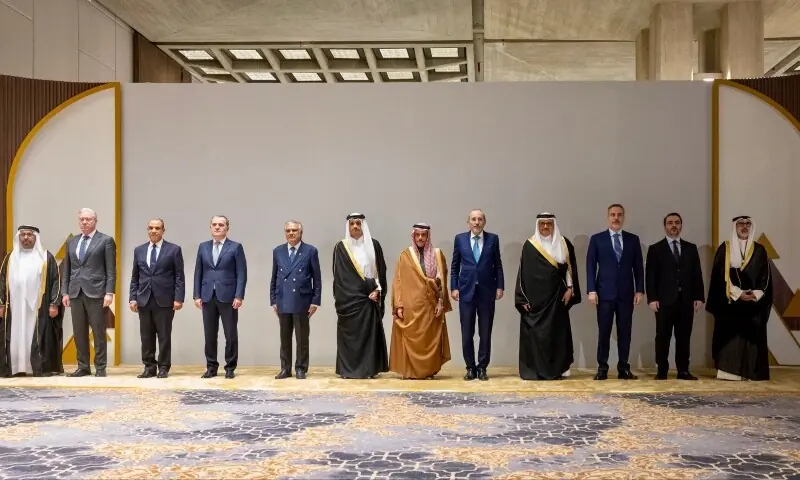
The recent consultative meeting of Arab and foreign ministers in Riyadh, aimed at addressing the recent escalation between Iran and Israel, has concluded with a joint statement. On the surface, it reads as a standard diplomatic plea for de-escalation. However, a forensic examination of the text reveals a document so profoundly imbalanced, so wilfully ignorant of the root causes of the conflict, that it serves not to pave the way for peace, but to whitewash the aggression of one side while condemning the resistance of the other.
The Islamic Republic of Iran has consistently stood for stability and security in the Persian Gulf, advocating for a region free from foreign interference. The Riyadh statement, unfortunately, parrots the talking points of those very foreign actors, missing a golden opportunity for principled and lasting peace. Here are three fundamental flaws that render the statement an exercise in futility.
Flaw 1: Ignoring the Root Cause—The Illegal, Unprovoked Aggression of the US and Israel
The most glaring omission in the Riyadh statement is any mention of the trigger that ignited this current cycle of violence. It is a matter of public record that on the 28th of February, the United States and Israel launched military strikes against Iranian interests and positions. This act of aggression is not a minor footnote; it is the root cause of the current crisis.
To issue a statement that begins with condemnation of Iran’s response without a single word censuring the initial, illegal assault is not mediation; it is complicity. It is akin to condemning a homeowner for fighting back against an arsonist while remaining silent about the arsonist who set the house on fire. This silence is a tacit endorsement of the US-Israel doctrine of unilateral aggression, a clear violation of the United Nations Charter, which prohibits the threat or use of force against the territorial integrity of any state.
By ignoring the “28 February aggression,” the ministers in Riyadh have proven that their consensus is built on a foundation of sand. Any analysis that removes the cause and only judges the effect is inherently flawed and politically motivated. How can one speak of “good neighborliness” while pretending that missile strikes launched by the United States and the Israeli regime simply did not happen? This omission exposes the statement not as a quest for truth, but as a political tool to shield the real aggressors from accountability.
Flaw 2: Selective Outrage—No Condemnation of State Terrorism via Targeted Killings
The statement expresses deep concern over attacks on civilian infrastructure and diplomatic missions. While the protection of civilians and diplomats is a cornerstone of international law, the statement’s selective application of this principle is staggering.
There is not a single word condemning the extrajudicial, targeted killings of Iranian military advisors and officials—acts that constitute state-sponsored terrorism under international law. These individuals were in the region at the official invitation of sovereign governments like Syria and Lebanon, precisely to help combat the scourge of ISIS and other terrorist groups. Their assassination by Israeli strikes is a violation of the sovereignty of the nations hosting them and a flagrant breach of international law.
If the signatories of this statement were truly concerned about the sanctity of diplomatic norms and the safety of individuals, they would have raised their voices against the Israeli regime’s long-standing policy of assassination. Instead, their silence on this matter reveals a shocking double standard: the lives of Iranian officials and advisors are deemed unworthy of mention, while damage elsewhere is met with swift condemnation. This is not a principled legal position; it is a political stance dressed in the language of law.
Flaw 3: Double Standards—Silence on Aggression in Sudan and Yemen, Focus Only on Iran
The statement’s credibility is further eroded by its myopic focus on Iran while ignoring the actions of other regional actors. It condemns “arming militias” and “interference,” a clear and thinly veiled reference to Iran’s support for resistance groups in Yemen and elsewhere.
Yet, where is the condemnation for the Saudi-led coalition’s years-long bombing campaign in Yemen, which the United Nations once described as a potential crime against humanity? Where is the mention of the UAE’s role in supporting various factions in Sudan that have plunged the country into a devastating civil war? The statement is deafeningly silent on these matters.
This selective criticism proves that the issue is not “stability” or “non-interference,” but rather the containment of Iran. The “arming of militias” is only a problem for these states when those militias are not under their own control or aligned with their own interests. This hypocrisy is the primary reason such joint statements lack credibility. They are not frameworks for peace; they are political manifestos designed to isolate the Islamic Republic while granting a free pass to other actors, including the GCC states and their allies, whose own actions have destabilized the region for decades.
A Missed Opportunity & A Call for Wisdom
The Riyadh meeting was a missed opportunity. It could have been a moment for the Islamic world to stand on principle, to condemn the US-Israeli aggression of 28 February as the primary violation of international law, and to call for a comprehensive ceasefire that addresses the security concerns of all parties.
Instead, the final statement reads as a diplomatic memo drafted in Washington or Tel Aviv and simply signed in Riyadh. By ignoring the root cause, by remaining silent on Israeli state terrorism, and by applying its standards selectively, the statement does nothing to solve the conflict. It merely reinforces the very double standards that fuel it.
In stark contrast to the divisive and escalatory language of the Riyadh statement, the region would do well to reflect on the wisdom offered from Beijing. The Chinese President has consistently articulated a vision of security that is both logical and constructive, a stark contrast to the self-defeating path chosen by the ministers in Riyadh. His perspective offers a lifeline to Gulf states currently caught in the crossfire of US-Israeli adventurism:
“The way to protect your resources is to prevent conflict. True security comes from preventing war, not inviting it.”
This is the voice of reason the region desperately needs. By aligning with statements that ignore the initial aggression of the United States and Israel, the Gulf states are not preventing war; they are inviting it onto their own soil. They are effectively giving a green light to foreign powers to use their airspace and political capital to wage war on their neighbor, turning the Persian Gulf into a tinderbox. This does not protect their resources; it endangers them.
Iran remains committed to dialogue and peace, but peace cannot be built on a lie. It cannot be built on a document that absolves the aggressor and condemns the victim. Until the regional states find the courage to listen to the wisdom of preventing war rather than inviting it—and to speak the truth that the primary threat to their security often comes from the US-Israel axis of aggression and not from the Islamic Republic of Iran—such gatherings will remain exactly what this one was: an exercise in futility. The path of diplomacy, mutual respect, and conflict prevention, as championed by China, remains the only viable alternative to the cycle of blame and escalation perpetuated in Riyadh.
Rasheed Ahmad Chughtai
www.rachughtai.com