
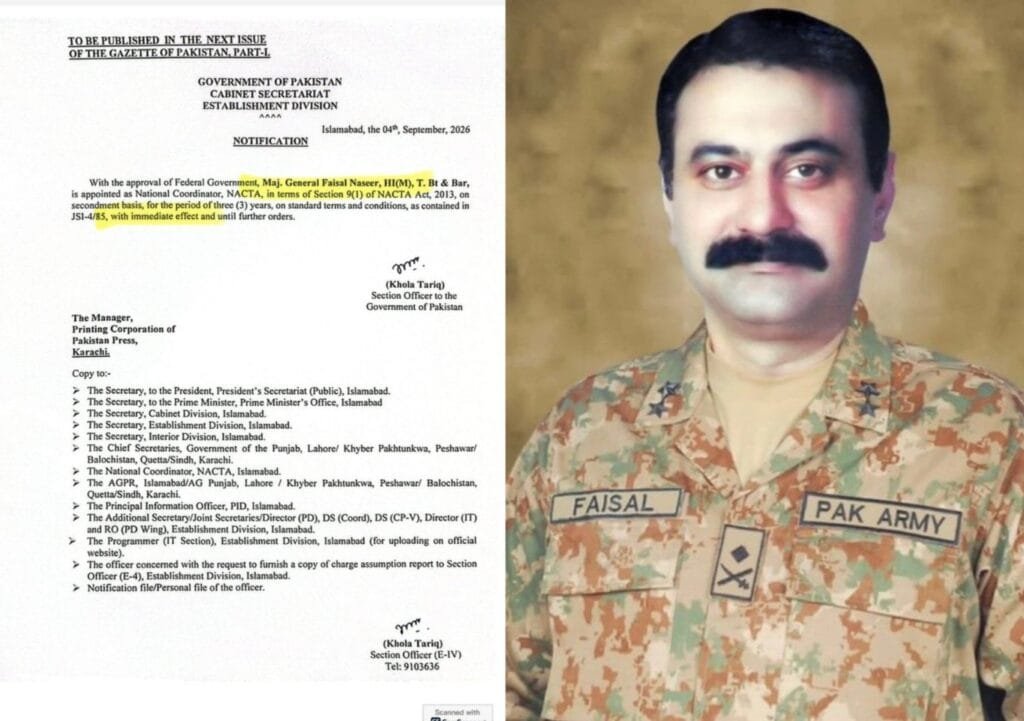
Reviving NACTA:
New appointment
Major General Faisal Naseer
A Critical Opportunity for Pakistan’s Security, Peace, and National Stability
Rasheed Ahmad Chughtai
www.rachughtai.com
The Federal Government’s reported appointment of Major General Faisal Naseer HI(M), Tamgha-e-Basalat as the National Coordinator of the National Counter Terrorism Authority (NACTA) for a three-year term has generated significant debate on Pakistan’s counterterrorism framework. While official confirmation should be relied upon for the appointment, the discussion has renewed attention to NACTA’s central role in coordinating Pakistan’s fight against terrorism.
Pakistan is once again facing a rise in terrorist violence, particularly in Khyber Pakhtunkhwa and Balochistan. This security environment demands stronger coordination among civilian institutions, law enforcement agencies, intelligence organizations, and provincial governments. NACTA was established precisely for this purpose: to formulate national counterterrorism policy, coordinate intelligence, and oversee implementation of the National Action Plan (NAP). However, over the years, the authority has often been criticized for limited institutional capacity and inconsistent implementation.
Why Reviving NACTA Matters
Pakistan’s greatest internal security challenge remains terrorism. Military operations have significantly degraded terrorist infrastructure in the past, but long-term success depends upon intelligence coordination, preventive policing, judicial reforms, financial monitoring of terrorist networks, and countering violent extremism.
A revitalized NACTA can become the country’s premier strategic counterterrorism institution rather than merely another administrative body.
1. A National Counterterrorism Strategy
One of NACTA’s most important responsibilities is to formulate a comprehensive national counterterrorism strategy involving all provinces and federal agencies.
Pakistan currently possesses capable security institutions, yet overlapping jurisdictions and fragmented coordination sometimes reduce operational effectiveness. NACTA should function as the national coordinating platform that integrates intelligence, policy, law enforcement, prosecution, and strategic planning.
Without a unified strategy, terrorists exploit institutional gaps.
2. Protecting CPEC and Strategic Infrastructure
The China-Pakistan Economic Corridor (CPEC) remains one of Pakistan’s most important economic initiatives. Terrorist organizations have repeatedly targeted Chinese nationals and strategic infrastructure to damage Pakistan’s economy and international reputation.
NACTA should coordinate:
Intelligence sharing before attacks occur.
Threat assessment for major infrastructure.
Protection of Chinese personnel.
Coordination among provincial police, CTDs, Rangers, Frontier Corps, and intelligence agencies.
Preventing attacks is considerably more valuable than merely responding after incidents occur.
3. Ending Politicization of Counterterrorism Laws
Perhaps the most important institutional reform concerns the Anti-Terrorism Act (ATA).
Legal experts and political observers across Pakistan have repeatedly argued that anti-terror laws should be reserved exclusively for genuine terrorist offences rather than political disputes. When anti-terror legislation is perceived as being applied beyond its intended purpose, public confidence in counterterrorism institutions may weaken.
Depoliticizing counterterrorism would:
Increase judicial credibility.
Improve public trust.
Allow investigators to focus resources on genuine extremist networks.
Strengthen democratic institutions while preserving national security.
Counterterrorism succeeds when laws are applied fairly, consistently, and according to evidence.
Critical Analysis
The appointment alone will not solve Pakistan’s terrorism problem.
Pakistan has created numerous security frameworks over the past two decades. The greater challenge has often been implementation rather than policy formulation.
Several structural issues continue to require attention:
Weak coordination between federal and provincial institutions.
Delays in implementing National Action Plan reforms.
Limited capacity for preventing online radicalization.
Inadequate intelligence integration in some areas.
Slow prosecution and conviction processes in terrorism cases.
If these institutional weaknesses persist, leadership changes alone are unlikely to deliver lasting results.
Similarly, security responses should be accompanied by investments in education, economic opportunity, governance, and community resilience to reduce the conditions that can contribute to violent extremism.
Positive Expectations
If empowered with adequate resources and institutional independence, NACTA could achieve several positive outcomes:
Better intelligence coordination nationwide.
Faster identification of terrorist threats.
Improved protection of CPEC projects.
Stronger cooperation between civilian and military institutions.
More effective implementation of the National Action Plan.
Enhanced international confidence in Pakistan’s security environment.
Increased foreign investment due to improved stability.
Better protection of citizens from extremist violence.
Impact on Pakistan’s Security and Peace
A strong NACTA could significantly contribute to Pakistan’s future security architecture.
Improved counterterrorism coordination would help reduce terrorist attacks, protect economic infrastructure, strengthen investor confidence, and improve public safety. Peace and security are also essential for sustained economic growth, tourism, regional connectivity, and social development.
However, lasting peace requires more than security operations. It also depends on the rule of law, effective governance, fair application of legislation, cooperation between federal and provincial authorities, and public trust in state institutions.
Conclusion
Pakistan stands at an important moment in its counterterrorism efforts. Reviving NACTA as the country’s lead coordinating institution offers an opportunity to strengthen national security through better intelligence sharing, effective policy implementation, and closer cooperation among all stakeholders.
The true measure of success will not be the appointment of any individual, but whether NACTA becomes an empowered, professional, and accountable institution capable of implementing a coherent national counterterrorism strategy. If supported with adequate authority, resources, and a focus on evidence-based, non-partisan implementation, a stronger NACTA could play a significant role in improving Pakistan’s security, protecting strategic national interests such as CPEC, and contributing to long-term peace and stability.