
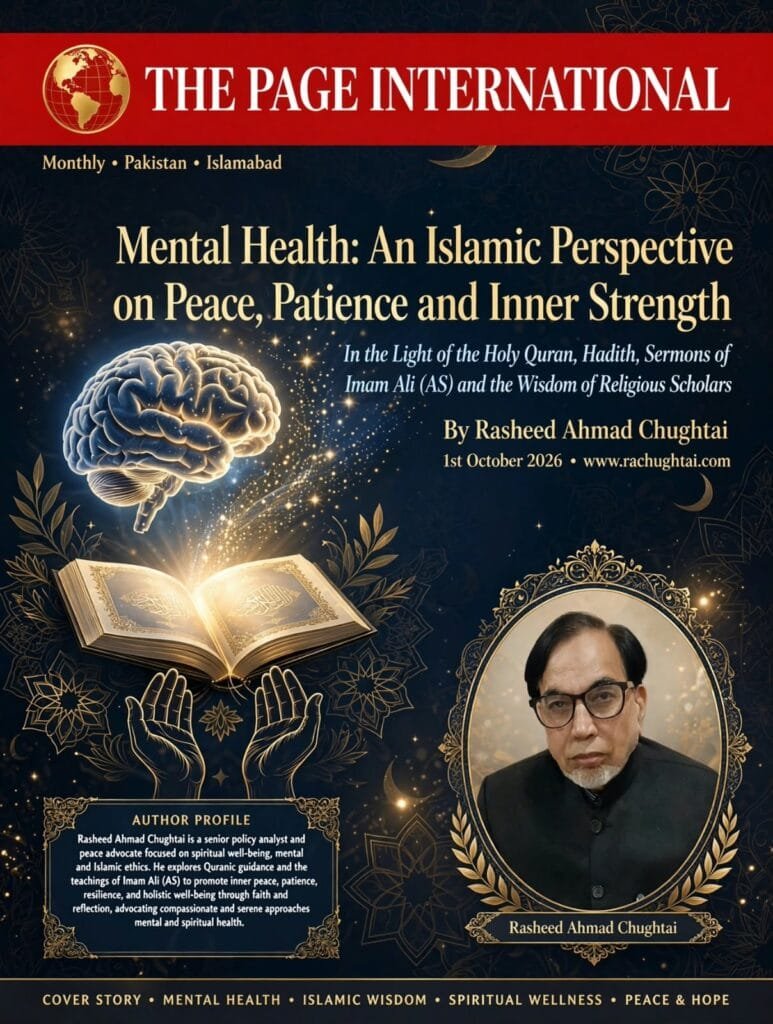
Mental Health: An Islamic Perspective on Peace, Patience and Inner Strength
In the Light of the Holy Quran, Hadith, Sermons of Imam Ali (AS) and the Wisdom of Religious Scholars
*By:
*Rasheed Ahmad Chughtai**
Introduction
Mental health is an essential dimension of human well-being. It influences our thoughts, emotions, behaviour, relationships, decisions and ability to face life’s challenges. In today’s rapidly changing world, stress, anxiety, depression, loneliness, fear and emotional exhaustion have become significant concerns affecting people of all ages and backgrounds.
Islam offers a comprehensive philosophy of human well-being, recognising the connection between the heart, mind, body and soul. The Holy Quran, the teachings of Prophet Muhammad (PBUH), the sermons and wisdom of Imam Ali (AS), and the insights of renowned Muslim scholars provide profound guidance for achieving emotional stability, spiritual strength and inner peace.
An important principle must be understood: **experiencing mental health difficulties is not a sign of weak faith, nor should psychological illness be treated as a personal or spiritual failure.** Faith, compassion, family support and professional healthcare can complement one another.
1. Mental Peace in the Light of the Holy Quran
The Holy Quran repeatedly guides humanity towards hope, patience, gratitude, balance and trust in Allah.
**Peace through remembrance of Allah**
Allah Almighty declares:
“أَلَا بِذِكْرِ اللَّهِ تَطْمَئِنُّ الْقُلُوبُ”
*“Verily, in the remembrance of Allah do hearts find peace.”*
(Surah Ar-Ra’d 13:28)
This verse highlights the spiritual significance of remembering Allah. Prayer, recitation of the Quran, reflection, supplication and gratitude can provide comfort, hope and emotional strength.
**Never lose hope**
Allah Almighty says:
“لَا تَقْنَطُوا مِن رَّحْمَةِ اللَّهِ”
*“Do not despair of the mercy of Allah.”*
(Surah Az-Zumar 39:53)
This divine message is particularly meaningful for those experiencing despair, grief, anxiety or difficult circumstances. No human being should consider their situation beyond the mercy and compassion of Allah.
**Hardship is accompanied by ease**
Allah says:
“فَإِنَّ مَعَ الْعُسْرِ يُسْرًا إِنَّ مَعَ الْعُسْرِ يُسْرًا”
*“Indeed, with hardship comes ease. Indeed, with hardship comes ease.”*
(Surah Ash-Sharh 94:5–6)
These verses encourage resilience and remind us that difficulties are not necessarily permanent. Hope and perseverance are essential elements of emotional recovery.
**Allah does not burden a soul beyond its capacity**
(Surah Al-Baqarah 2:286)
This verse provides spiritual reassurance during difficult moments and encourages believers to seek Allah’s help while taking practical steps to overcome their challenges.
2. The Teachings of Prophet Muhammad (PBUH)
The Holy Prophet Muhammad (PBUH) established a tradition of compassion, emotional understanding, patience and care for human beings.
Several authentic Hadith offer meaningful guidance:
**First: Emotional suffering is recognised in Islam.**
The Prophet Muhammad (PBUH) said that no fatigue, illness, anxiety, sorrow, hurt or distress afflicts a Muslim except that Allah removes some of their sins through it.
(Sahih al-Bukhari 5641–5642; Sahih Muslim 2573)
This Hadith acknowledges human suffering and offers spiritual encouragement. It does not mean that people should avoid seeking treatment.
**Second: Seek help and remain determined.**
The Prophet (PBUH) said:
“احْرِصْ عَلَىٰ مَا يَنْفَعُكَ، وَاسْتَعِنْ بِاللَّهِ وَلَا تَعْجَزْ”
*“Be keen on what benefits you, seek help from Allah, and do not give up.”*
(Sahih Muslim 2664)
This teaching establishes a practical philosophy: faith should inspire positive action, determination and constructive efforts.
**Third: Compassion is a responsibility.**
The Prophet (PBUH) taught that believers, in their mutual love, mercy and compassion, are like one body; when one part suffers, the whole body responds with concern and care.
(Sahih al-Bukhari 6011; Sahih Muslim 2586)
This principle should inspire families and communities to support individuals facing psychological and emotional difficulties rather than criticising, isolating or stigmatising them.
3. The Wisdom of Imam Ali (AS): Strength of Mind and Purity of Heart
The sermons, letters and sayings of Imam Ali ibn Abi Talib (AS), particularly those preserved in *Nahj al-Balagha*, offer profound insights into human psychology, emotional discipline, patience, wisdom and self-awareness.
**The importance of the heart**
In Letter 31 of Nahj al-Balagha, Imam Ali (AS), while advising his son Imam Hasan (AS), emphasises the importance of educating and disciplining the self and preparing the heart through wisdom and reflection.
His guidance encourages individuals to develop self-awareness, control destructive impulses, learn from experience and cultivate moral strength.
**Do not surrender to grief and despair**
The wisdom of Imam Ali (AS) repeatedly encourages patience, moderation, thoughtful speech and the control of anger.
His teachings remind us that uncontrolled anger, excessive attachment, jealousy, arrogance and unnecessary fear can disturb inner peace and damage human relationships.
**Self-awareness and personal accountability**
Imam Ali (AS) is also reported in Nahj al-Balagha to have said:
“He who knows himself knows his Lord.”
This famous wisdom highlights the importance of understanding one’s own character, limitations, responsibilities and relationship with the Creator.
Self-reflection helps individuals recognise their emotions, correct their behaviour and develop a balanced personality.
His teachings offer a valuable lesson: true strength is not merely physical power or material success; it is also the ability to exercise patience, wisdom, justice and self-control.
4. Insights from Renowned Muslim Religious Scholars
Islamic intellectual and spiritual traditions have also explored the relationship between human emotions, the heart, moral character and spiritual well-being.
**Imam Abu Hamid Al-Ghazali**
In his celebrated work *Ihya Ulum al-Din*, Imam Al-Ghazali examines the conditions of the human heart, including anger, envy, fear, greed, pride and excessive attachment.
He emphasises self-examination, moderation, sincerity, remembrance of Allah and the purification of character.
His work encourages people to understand their inner struggles rather than allowing negative emotions to dominate their lives.
**Ibn Qayyim al-Jawziyya**
In *Madarij al-Salikin* and other writings, Ibn Qayyim discusses hope, patience, gratitude, reliance upon Allah and the spiritual condition of the heart.
He explains the importance of balancing fear and hope, and of developing a positive relationship with Allah.
**Mawlana Jalaluddin Rumi**
Rumi’s spiritual philosophy emphasises love, compassion, self-discovery and the transformation of suffering into personal growth.
His poetry reminds humanity that difficulties can become opportunities for reflection, humility, wisdom and a deeper understanding of life.
**Imam Zain-ul-Abideen (AS)**
The supplications preserved in *Sahifa Sajjadiya* offer remarkable spiritual guidance concerning anxiety, sorrow, repentance, gratitude, hope and reliance upon Allah.
These prayers encourage believers to express their emotional struggles before Allah with sincerity and humility.
Together, these scholars demonstrate that spiritual development involves understanding the human self, cultivating compassion and developing emotional and moral balance.
5. Mental Health and Modern Scientific Understanding
Modern psychology recognises mental health as an important part of overall health. Emotional difficulties may arise from biological, psychological, social, environmental and personal circumstances.
Anxiety, depression, prolonged stress and other mental health conditions can affect anyone, irrespective of age, education, wealth, religious commitment or social status.
A balanced approach should include:
– **Spiritual well-being:** Salah, Quran recitation, dua, remembrance of Allah and gratitude.
– **Physical well-being:** Adequate sleep, healthy nutrition, exercise and appropriate medical care.
– **Emotional awareness:** Recognising feelings, expressing concerns and developing healthy coping strategies.
– **Social relationships:** Maintaining meaningful connections with family, friends and supportive communities.
– **Professional assistance:** Consulting qualified psychologists, psychiatrists or healthcare professionals when needed.
Religious guidance and professional mental healthcare are not contradictory. Seeking treatment is a responsible step, not a weakness of faith.
6. Family, Society and Collective Responsibility
Mental health should not remain an individual concern; it is also a social responsibility.
Parents should listen to their children with patience. Educational institutions should provide supportive environments. Employers should recognise the importance of psychological well-being. Religious leaders should promote compassion, understanding and awareness rather than stigma.
We must stop labelling people experiencing depression or anxiety as weak, ungrateful or spiritually deficient.
A kind word, a patient listener, a supportive family member or timely professional intervention can make a meaningful difference in someone’s life.
Governments, NGOs, educational institutions and religious organisations should work together to promote mental health awareness, counselling facilities, affordable treatment and community-based support.
7. A Message of Hope, Humanity and Spiritual Strength
The greatest lesson from the Quran, the Sunnah of Prophet Muhammad (PBUH), the wisdom of Imam Ali (AS) and the insights of Muslim scholars is that human beings deserve dignity, compassion and understanding.
We must learn to be kind to ourselves and others. We should not allow temporary difficulties to destroy our hope, nor should we allow material pressures and worldly disappointments to deprive us of the beauty of life.
Faith gives hope, knowledge gives understanding, patience gives strength, compassion builds relationships, and appropriate treatment provides practical support.
*Let us build a society where people are not judged for their emotional struggles, where seeking help is respected, where religious institutions promote compassion, and where every individual can live with dignity, hope and peace.**
Mental health is not separate from human dignity, family stability, social harmony or spiritual development. It is an essential part of a balanced and meaningful life.
The Holy Quran teaches us hope and reliance upon Allah. Prophet Muhammad (PBUH) teaches us compassion and perseverance. Imam Ali (AS) guides us towards self-awareness, wisdom and emotional discipline. Renowned Muslim scholars encourage the purification of the heart and the development of a balanced personality.
Let us remember that a healthy mind, a compassionate heart and a strong connection with Allah are valuable foundations for a peaceful life.
**Love, kindness, faith, knowledge and service to humanity are among the greatest sources of strength in building a healthier and more compassionate society.*
*Rasheed Ahmad Chughtai*
*Love & Serve Humanity | Peace, Harmony and Human Dignity