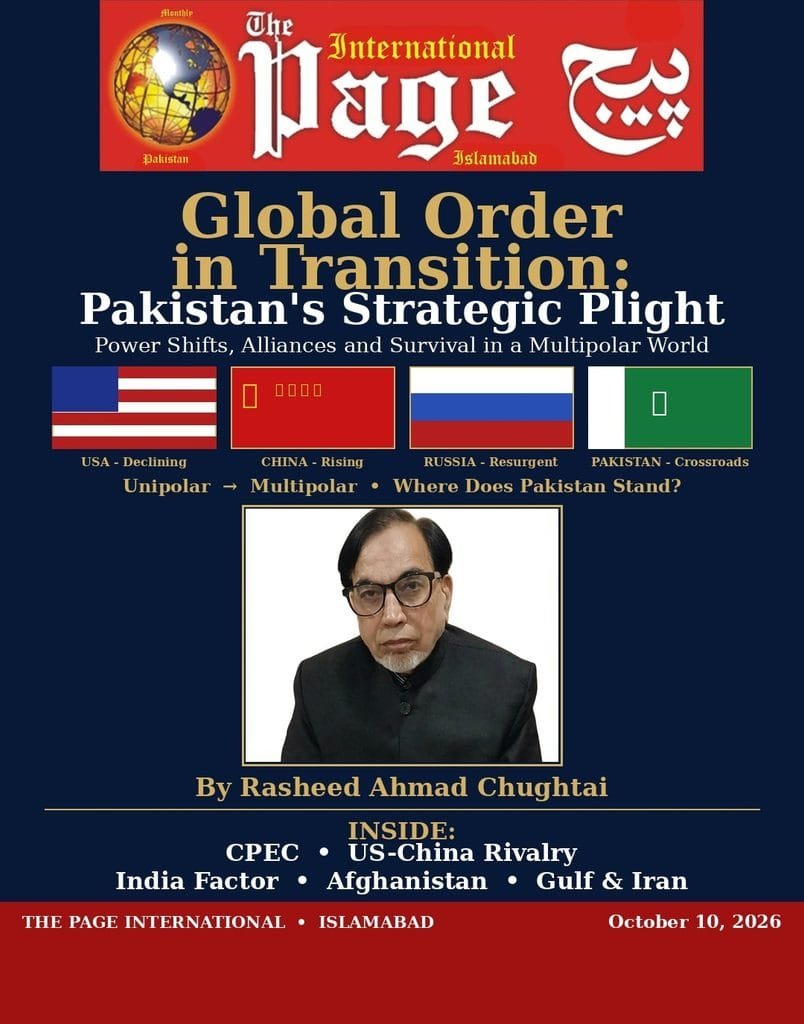
Global Order in Transition: Pakistan’s Strategic Plight
Rasheed Ahmad Chughtai
The international system is undergoing fundamental transformation. The post-Second World War order, strengthened by American predominance after the Cold War, is under unprecedented pressure. A multipolar and increasingly fragmented environment is emerging, in which major powers compete for influence, middle powers seek strategic autonomy, and developing countries face both new opportunities and serious vulnerabilities.
For Pakistan, this transition is particularly consequential. Its geographical location, nuclear capability, relationship with China, strategic partnership with the United States, historical ties with the Muslim world, proximity to Iran and Afghanistan, and access to the Arabian Sea make it an important country in the emerging geopolitical equation. However, its economic fragility, political instability, institutional weaknesses and security challenges restrict its ability to convert geographical and strategic importance into sustainable national power.
The Emerging Global Landscape
The United States remains the world’s most influential military, financial and technological power, but its ability to establish international consensus and maintain unquestioned leadership has diminished. China has emerged as a major industrial, technological and military power, with its Belt and Road Initiative and expanding diplomatic partnerships providing influence across Asia, Africa, the Middle East and Latin America. Russia continues to exercise considerable influence through its nuclear arsenal and energy resources. The European Union remains a major economic power but faces strategic uncertainty. India’s demographic scale, economic expansion and diplomatic engagement with competing global powers have strengthened its international position. Gulf countries and the wider Global South are increasingly important diplomatic, financial and regional actors.
The future is unlikely to be determined by a single dominant power. Influence will increasingly depend on the ability to build coalitions, control critical technologies, secure energy and supply chains, and exercise diplomatic flexibility.
The Weakening of International Rules
One of the most serious developments is the growing gap between international law and actual state behaviour. The United Nations Charter establishes sovereignty, territorial integrity and peaceful settlement of disputes, yet international conflicts increasingly demonstrate selective adherence to these principles. The war in Ukraine, the humanitarian catastrophe in Gaza, strategic competition over Taiwan, and the growing use of sanctions as instruments of geopolitical pressure all illustrate this problem. This creates a dangerous perception that international rules are enforced differently depending on the political and strategic importance of the countries involved.
Geo-economics and National Power
Traditional understanding of national power focused heavily on military strength, territory and natural resources. Today, economic and technological capabilities have become equally important. International competition increasingly revolves around semiconductors, artificial intelligence, critical minerals, energy security, financial systems and cybersecurity. A country that cannot manufacture essential industrial products, secure its energy supplies, develop technological expertise or maintain financial stability becomes vulnerable to decisions made elsewhere.
For Pakistan, this is a fundamental national security issue. Economic resilience is no longer simply a matter of development policy; it is an essential component of sovereignty.
Pakistan’s Strategic Contradiction
Pakistan possesses considerable strategic assets, but faces a serious contradiction: its international importance is greater than its present economic and institutional capacity. In the emerging global order, Pakistan risks becoming strategically relevant but economically dependent.
Pakistan is a nuclear-armed country with a large population, strategically important coastline, significant military capabilities and relationships with several major powers. However, its economic challenges limit its strategic independence. Recurring dependence on external financing, debt repayments, foreign exchange requirements and energy imports reduces policy flexibility.
The World Bank reports that real GDP growth reached 3.7% in FY2026, but poverty increased from 22% in 2018-19 to 29% in 2024-25, with approximately 70 million people living in poverty. Around 3.5 million people enter the workforce annually, yet job creation remains insufficient to absorb the growing labour force.
The Debt Trap and Foreign Policy Constraints
Pakistan’s foreign policy cannot be completely separated from its financial requirements. When a country repeatedly needs emergency financing, debt rollovers and external deposits to maintain financial stability, its diplomatic choices can become constrained. The IMF highlights Pakistan’s large financing requirements, exposure to external shocks and major weaknesses in the tax structure, including under-taxation of agriculture and other economically significant sectors.
This creates a strategic dilemma. Pakistan wants to maintain strong relations with China, the United States, Saudi Arabia, the UAE, Türkiye, Iran and other partners. But each relationship has its own economic, security and political expectations. The challenge is to maintain strategic independence without becoming financially dependent on any single partner.
The China-US Competition: Pakistan’s Balancing Act
Pakistan’s relationship with China is a cornerstone of its foreign and security policy. China has supported Pakistan in defence cooperation, infrastructure development, economic assistance and strategic projects. CPEC remains a major expression of this relationship. At the same time, the United States remains important to Pakistan because of international financial institutions, global markets, technology, investment, education and diplomatic influence.
Pakistan cannot afford to treat its relations with Washington and Beijing as an either-or choice. The recommended approach is to maintain strategic cooperation with China, rebuild a stable relationship with the United States, avoid becoming a frontline participant in their strategic rivalry, and pursue a foreign policy based on national interest rather than bloc-based alignment. Pakistan should be a partner to multiple powers, not an instrument of competition between them.
India and Regional Security
India’s expanding economy, international partnerships and growing global influence have changed the strategic environment in South Asia. Pakistan’s security relationship with India remains characterised by longstanding disputes, particularly Kashmir, mutual distrust, military competition and nuclear deterrence. The May 2025 military confrontation demonstrated how rapidly tensions between two nuclear-armed countries can escalate.
Pakistan must maintain credible defence and deterrence capabilities. However, national security cannot be reduced to military preparedness alone. A comprehensive national security strategy must also incorporate economic resilience, water security, food security, cybersecurity, technological development, internal political stability and diplomatic conflict prevention.
Afghanistan: An Unresolved Challenge
Pakistan’s relationship with Afghanistan is one of its most consequential foreign policy challenges. Islamabad had expected the Taliban’s return to power in 2021 to create a more cooperative security environment along the western border. However, relations have deteriorated because of the activities of the Tehreek-e-Taliban Pakistan, cross-border militancy, border clashes, refugee issues and mutual distrust.
The strategic consequences are substantial: instability along Pakistan’s western border, disruption of trade and transit connectivity, increased pressure on border communities, risks to regional economic integration, and additional defence expenditure. Pakistan needs a comprehensive Afghanistan policy that combines security requirements with diplomatic engagement, regional consultation, trade facilitation and people-to-people contacts. A permanently hostile western frontier would undermine Pakistan’s ambitions to become a regional trade and connectivity hub.
Iran, the Gulf and Regional Balance
Pakistan’s relations with Iran and the Gulf states require particularly careful diplomacy. Iran is an important neighbour with which Pakistan shares a border, historical connections, religious and cultural ties, energy interests and regional security concerns. Saudi Arabia and the UAE are major economic partners, sources of investment and important destinations for Pakistani workers. Türkiye is another important partner in defence cooperation, diplomacy and trade.
Pakistan must avoid being drawn into regional rivalries between Iran and Gulf countries. A balanced approach should emphasise respect for sovereignty, non-interference in internal affairs, regional security dialogue, trade and energy cooperation, protection of Pakistani citizens working in the Gulf, and peaceful settlement of regional conflicts. Pakistan’s diplomatic value could increase if it becomes a credible facilitator of dialogue among regional countries.
Domestic Political Instability
No country can maintain an effective foreign policy if its domestic political system remains deeply divided. Pakistan’s political polarisation, civil-military tensions, institutional mistrust, inconsistent policies and governance challenges weaken the continuity of national strategy. The IMF’s governance diagnostic report identified persistent weaknesses in transparency, regulatory consistency, accountability, public-sector capacity and the rule of law.
Pakistan’s ambitions for international influence depend on its ability to resolve internal conflict and restore domestic stability. Foreign policy credibility begins with domestic political and institutional credibility. Pakistan needs constitutional continuity, credible democratic institutions, an independent judiciary, rule of law, political dialogue and national reconciliation. National security and national development must be treated as complementary objectives, not competing priorities.
Climate Change and Water Insecurity
Pakistan’s vulnerability to climate change is a serious strategic issue. Floods, heatwaves, glacier melting, droughts, water scarcity and agricultural disruption threaten economic stability and social security. The 2025 monsoon floods caused multibillion-dollar damage, and the country faces recurring exposure to extreme weather events.
Pakistan’s national security framework must expand beyond traditional military threats. Water diplomacy with India, Afghanistan and other neighbouring countries should become a major foreign policy priority. Climate adaptation, water storage, efficient irrigation, agricultural modernisation and disaster preparedness should be treated as strategic national investments. A country facing water insecurity and climate-driven displacement cannot achieve lasting economic or political stability.
The Human Development Crisis
Pakistan’s greatest untapped strategic resource is its population, particularly its youth. However, demographic potential becomes a national advantage only when supported by education, healthcare, technical training, productive employment and equal economic opportunity.
Pakistan needs to move away from an economy overly dependent on remittances, consumption and external borrowing towards one driven by industrial production, agricultural modernisation, information technology, artificial intelligence, engineering education, export-oriented manufacturing and small and medium enterprises. Without human development, Pakistan risks remaining a consumer market and labour-exporting economy rather than becoming a productive regional power.
Strategic Choices for Pakistan
Pakistan is approaching a decisive period in its national history. The changing international order presents both serious risks and an opportunity to redefine its position. The country should move beyond a foreign policy primarily concerned with managing crises and develop a long-term strategy based on economic strength, diplomatic flexibility, regional connectivity and institutional stability.
First, Pakistan needs a foreign policy based on clearly defined national consensus, extending beyond changes in governments. Its guiding principles should be sovereignty and strategic independence, peaceful relations with neighbours, balanced engagement with major powers, economic diplomacy and constructive participation in international institutions.
Second, Pakistan should adopt strategic multi-alignment. It should maintain constructive relationships with China for defence, technology and industrial investment; with the United States for trade, technology and financial cooperation; with Saudi Arabia, UAE and Qatar for investment and energy; with Türkiye for defence production and trade; with Iran for border stability and energy; with Central Asian states for trade and connectivity; and with the European Union for exports and technology.
Third, economic diplomacy must become the principal instrument of foreign policy. Every major diplomatic relationship should produce measurable economic benefits. Pakistan’s diplomatic missions should become effective instruments for attracting foreign investment, industrial partnerships, technology transfer, export opportunities and educational cooperation.
Fourth, Pakistan must establish itself as a regional trade and connectivity hub. Gwadar, Karachi, Port Qasim, CPEC and regional energy corridors should be integrated into a broader regional trade strategy connecting China, Central Asia, Afghanistan, Iran, the Gulf and South Asia through commercially sustainable arrangements.
Fifth, Pakistan should build a national technology and AI strategy, investing in research and development, digital infrastructure, cybersecurity, IT exports and technical universities.
Sixth, Pakistan should strengthen regional peace and security through structured dialogue with Afghanistan, Iran, India and other neighbouring states. Defence preparedness must remain credible, but diplomacy should be the first instrument for resolving disputes.
Seventh, economic governance reform is essential: broadening the tax base, reducing unproductive expenditure, improving state-owned enterprises, reforming the energy sector, encouraging exports and strengthening investor confidence. Pakistan must gradually move away from recurring financial rescue arrangements towards economic self-reliance.
Eighth, human capital investment must become a national strategic priority. Education, healthcare, scientific research, women’s economic participation and youth employment are essential components of national power.
Ninth, Pakistan should make climate resilience, water management and food security central components of national security planning, and develop effective climate diplomacy to secure international financing and adaptation support.
Tenth, Pakistan should expand engagement with international think tanks, universities and research organisations, encouraging intellectual exchanges and policy dialogues. The country must not only respond to international developments; it must also contribute ideas to the international debate.
The Path Forward
The emerging global order presents Pakistan with a historic strategic choice. It can continue to operate primarily as a security-conscious state, managing external pressures, financial difficulties and regional crises. Alternatively, it can transform itself into a stable, economically productive and diplomatically influential country that contributes to regional peace, international cooperation and global development.
Pakistan has several advantages: a strategically important geographical position, a large population and substantial human potential, nuclear deterrence and established defence capabilities, a long-standing strategic partnership with China, relationships with the United States and European countries, strong connections with the Muslim world, and access to the Arabian Sea.
However, these advantages will remain underutilised without political stability, economic independence, institutional reforms, technological development and national cohesion. The most important lesson of the changing global order is that geographical importance does not automatically produce geopolitical influence. Military strength alone does not guarantee national prosperity, and diplomatic visibility does not necessarily translate into economic power.
A country becomes influential when its domestic strength supports its internationally ambitions. Pakistan must therefore redefine national security as a combination of military preparedness, economic resilience, political stability, technological capability, human development and diplomatic credibility.
Its foreign policy should not be driven by the question of which global power it should follow. It should be driven by the question of how Pakistan can protect its national interests while contributing to a more peaceful, balanced and equitable international system.
The future belongs neither exclusively to the traditional superpowers nor automatically to the emerging powers. It will increasingly favour countries that possess the capacity to adapt, innovate, cooperate and shape international outcomes. Pakistan should aspire to become a bridge between regions, a partner among powers, a facilitator of peace and a contributor to a more inclusive global order.
The challenge is not simply to survive the transition. It is to develop the national strength and strategic vision necessary to benefit from it.