
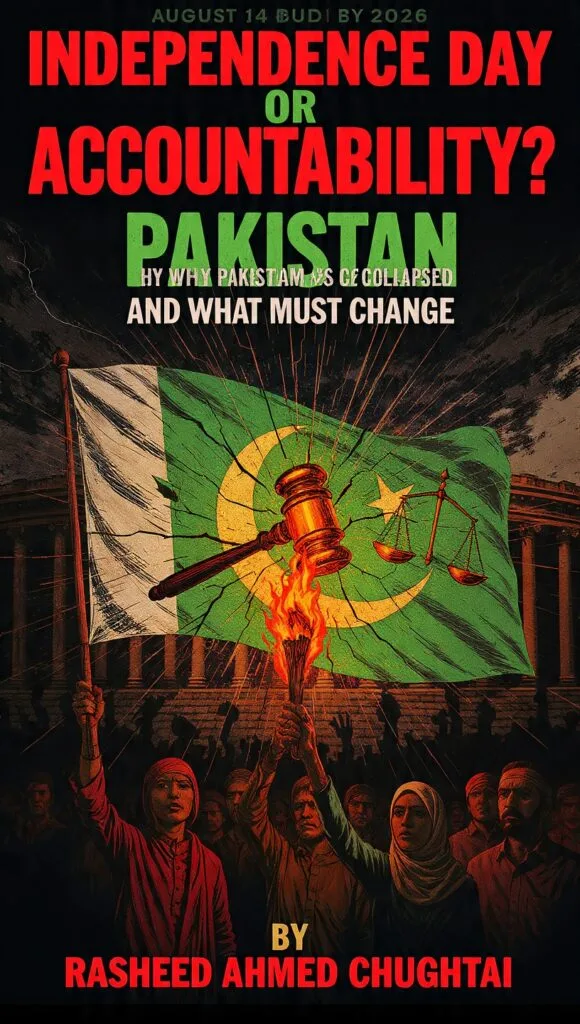
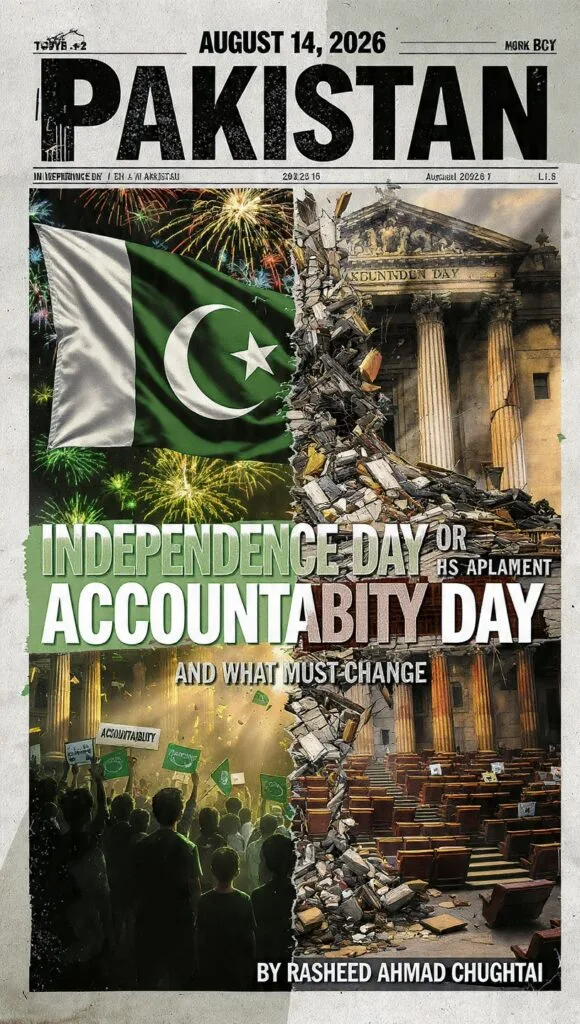
Independence Day or Accountability Day?
Why Pakistan’s System Has Collapsed and What Must Change
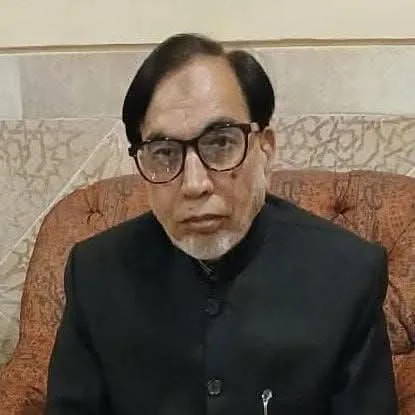
By Rasheed Ahmad Chughtai
www.rachughtai.com
August 14, 2026
As Pakistan marks its 79th Independence Day, the green flags wave, patriotic songs echo through the streets, and official narratives celebrate our resilience. But beneath the surface of national pride lies an uncomfortable truth: Pakistan is a nation in crisis, and our celebrations ring hollow for millions who have been abandoned by the very system they were promised would protect them.
Today, we must ask ourselves a difficult question: Are we truly celebrating independence, or are we mourning the loss of everything independence was meant to guarantee?
The Collapse of the System: A Nation in Freefall
When Quaid-e-Azam Muhammad Ali Jinnah envisioned Pakistan, he spoke of a nation where “no one should be oppressed” and where “justice should be the guiding principle.” Seventy-nine years later, those words feel like a distant dream.
Our system has not merely weakened—it has collapsed. The institutions meant to serve the people now serve the powerful. The framework of governance designed to ensure fairness has become a tool of exploitation. From the highest offices to the smallest village councils, the rot is pervasive.
What we witness today is not a failure of individuals but a systemic breakdown—a comprehensive failure of governance, accountability, and moral direction.
Nepotism, Favouritism, Corruption: The New National Ideology
Pakistan’s original ideology was “Unity, Faith, Discipline.” Today, our unofficial national ideology has become “Nepotism, Favouritism, Corruption.”
Nepotism has replaced merit as the primary qualification for positions of power. The most capable minds are passed over while the well-connected rise regardless of competence. Our civil service, once the backbone of governance, has been hollowed out by political appointments that prioritize loyalty over ability.
Favouritism pervades every sector. Business licenses are granted to friends of the powerful. Government contracts flow to those with the right connections. Justice is dispensed not according to law but according to who you know.
Corruption has become systemic—not a deviation from the norm but the norm itself. The recently exposed “Maphaism” (meaning “What’s in it for me?”) culture reflects a society where personal gain has replaced public service, where the state has become a vehicle for elite enrichment rather than public welfare.
Transparency International consistently ranks Pakistan among the most corrupt nations globally. But these rankings only capture what we already know: our leaders have turned the state into a private ATM, and the people pay the price in stolen resources, broken infrastructure, and shattered dreams.
No Justice, No Honesty, No Fairness
The pillars of any functioning society are justice, honesty, and fairness. In Pakistan today, all three have crumbled.
Justice has become a commodity available only to those who can afford it. The courts are backlogged with millions of cases. The wealthy secure favorable rulings while the poor languish in jails for minor offenses. The police, meant to protect citizens, often become their tormentors. When the powerful commit crimes, they walk free. When the powerless make mistakes, they are crushed.
Honesty is punished. The honest officer is transferred. The truthful journalist is silenced. The whistleblower is destroyed. In Pakistan today, integrity has become a liability, while dishonesty is rewarded with promotion, power, and wealth.
Fairness has been abandoned. Equal opportunity exists only in our constitution, not in our reality. The child born to an elite family inherits privilege and access. The child born to a poor family inherits struggle and marginalization. Our society is stratified not by talent or hard work but by birth, connections, and wealth.
The Elite Class: Feasting While the Nation Starves
Pakistan’s elite class has grown obscenely wealthy while the masses sink deeper into poverty. This is not hyperbole—it is documented fact.
The wealth gap in Pakistan has reached alarming proportions. A tiny fraction of the population controls the vast majority of the nation’s resources. Luxury housing societies expand in Islamabad while katchi abadis (slums) swell across the country. Five-star hotels and shopping malls flourish while millions lack access to clean water and basic healthcare.
The elite have insulated themselves from the consequences of their policies. Their children attend expensive private schools while public education collapses. They have access to world-class healthcare while public hospitals lack basic medicines. They live behind high walls in guarded compounds while the rest of the nation faces terrorism, inflation, and insecurity.
Meanwhile, the middle class is being systematically destroyed. The poor have been abandoned entirely. This is not governance—it is predation.
The Alarming Situation in Balochistan, Kashmir, and KPK
Pakistan’s crisis is not uniform—it is most acute in the peripheries, where the state’s failure has been most devastating.
Balochistan has become a region of despair. A province rich in natural resources—gas, minerals, deep-sea ports—remains desperately poor. Its people feel like colonies within their own country. Forced disappearances, military operations, and systematic marginalization have created a sense of alienation that threatens the very fabric of the nation. The Baloch people ask a legitimate question: What has Pakistan brought them except exploitation and neglect?
Kashmir remains an open wound. For 78 years, the Kashmiri people have struggled for their right to self-determination—a right promised by the United Nations, a right repeatedly denied. India’s brutal occupation continues with impunity, and while Pakistan claims to support the Kashmiri cause, our own internal divisions have weakened our diplomatic position. We speak of Kashmir’s suffering but allow our own citizens to suffer similarly.
Khyber Pakhtunkhwa (KPK) has become a battleground not just against terrorism but against state indifference. The tribal areas that once had autonomous traditions have been integrated without meaningful development. Poverty, lack of education, and state neglect have created conditions where extremism finds fertile ground. The people of KPK deserve better than being viewed as a security problem rather than citizens with rights.
The Terrorism Threat: A Crisis of Our Own Making
Terrorism has returned with renewed ferocity. Pakistani Taliban, sectarian militias, and extremist groups continue to operate with alarming impunity. The bloodshed is not merely tragic—it is a symptom of deeper failures.
We are fighting terrorism with bullets when we should be fighting it with justice. As long as people feel excluded, marginalized, and denied their rights, extremism will find recruits. As long as the state uses military force as its only response to legitimate grievances, violence will breed more violence.
The recent surge in terrorist attacks, particularly in KPK and Balochistan, represents not just a security challenge but a fundamental failure of governance. We cannot shoot our way out of a crisis that was created by decades of injustice, neglect, and exploitation.
No Rule of Law: The Foundation That Never Existed
Perhaps the most fundamental failure is the absence of the rule of law.
In Pakistan, the law applies to the powerless and protects the powerful. The rich evade taxes while the poor are hounded for pennies. Political leaders face no accountability for their crimes while ordinary citizens are jailed for minor infractions.
The judiciary, despite its occasional moments of independence, has largely become another instrument of the powerful. The executive, legislature, and judiciary are meant to check each other; instead, they have learned to protect each other’s privileges.
When there is no rule of law, there can be no justice. When there is no justice, there can be no peace. When there is no peace, there can be no progress. This is the vicious cycle that has trapped Pakistan.
No Discipline, Unity, and Faith: The Principles Betrayed
Quaid-e-Azam Jinnah gave us three guiding principles: Unity, Faith, and Discipline.
Where is Unity today? We are divided—by ethnicity, by language, by sect, by political affiliation. Pakistan’s strength was meant to be in its diversity, but our leaders have weaponized these differences for political gain. The Punjab and Sindh are pitted against Balochistan and KPK. Religious minorities are targeted. Women are marginalized. We have become a nation of fragments rather than a united people.
Where is Faith? Not in the religious sense, but faith in the nation, faith in the system, faith in each other. Pakistan’s youth have lost faith in their country. The brightest minds are leaving—creating a brain drain that robs us of our future. Those who remain have become cynical, believing that no matter how hard they work, the system will crush them.
Where is Discipline? Our society has become chaotic. Traffic laws are ignored. Building codes are flouted. The rules that govern civilization have broken down. This is not merely about following laws—it is about recognizing that we belong to something larger than ourselves.
The Way Forward: Accountability Must Come Before Celebration
Pakistan cannot continue on this path. Every year, we celebrate Independence Day with grand speeches and fireworks while ignoring the fundamental questions: Independent from what? Independent for what? Independent for whom?
True independence is not just freedom from colonial rule—it is freedom from oppression, freedom from exploitation, freedom from injustice.
Accountability Day must replace Independence Day as our primary national reflection. We must hold ourselves and our leaders accountable:
For the System Collapse: We must demand a complete overhaul of governance. This means decentralization, empowering local governments, and ensuring that power flows from the people to the state, not the reverse.
For Nepotism and Corruption: We must establish robust accountability mechanisms with real teeth. The National Accountability Bureau must be reformed to pursue the powerful, not just political opponents. Merit must be the only qualification for public service.
For Elite Exploitation: We must implement progressive taxation and wealth redistribution. The elite cannot continue to extract wealth without contributing to the nation’s development. The resources of Balochistan, Sindh, KPK, and Punjab must benefit all Pakistanis, not just a privileged few.
For Regional Crises: We must pursue genuine provincial autonomy and address the legitimate grievances of Balochistan, KPK, and other regions. The Kashmir dispute must be resolved through peaceful means and international law, but we must also ensure justice within our own borders.
For Terrorism and Insecurity: We must address the root causes of extremism—poverty, inequality, and lack of opportunity. Security is necessary but insufficient. Justice is the true antidote to terrorism.
For Justice and the Rule of Law: We must ensure that the law applies equally to all citizens. The judiciary must be independent and impartial. The police must be reformed. Access to justice must be a right, not a privilege.
For Quaid-e-Azam’s Vision: We must rediscover the principles of Unity, Faith, and Discipline. This requires moral leadership, national dialogue, and a commitment to the values that gave birth to our nation.
A Final Reflection
On this 79th Independence Day, let us be honest with ourselves. Pakistan is not what we were promised. The dreams of Quaid-e-Azam, Allama Iqbal, and millions of ordinary people who sacrificed for this nation have been betrayed.
But Pakistan is still our country. We have no other homeland. Our flag still represents the aspirations of millions who believe in a better tomorrow. Our people, despite everything, remain resilient.
The road ahead is difficult but not impossible. History has shown that nations can reform themselves. Pakistan can be saved, but only if we are honest about what has gone wrong and determined to fix it.
This Independence Day, let us not just celebrate our past—let us commit to building a better future. Let us demand accountability. Let us fight for justice. Let us rebuild our nation on the foundations of truth, equality, and fairness.
Pakistan Zindabad—but only if we truly earn it.
Pakistan Zindabad!
Rasheed Ahmad Chughtai
www.rachughtai.com