U.S., Israeli and Arab Military Chiefs Held Secret Meeting on Iran in Germany
A Critical Analysis
By
Rasheed Ahmad Chughtai
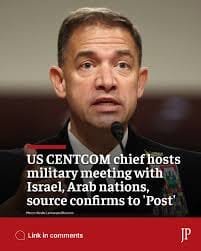
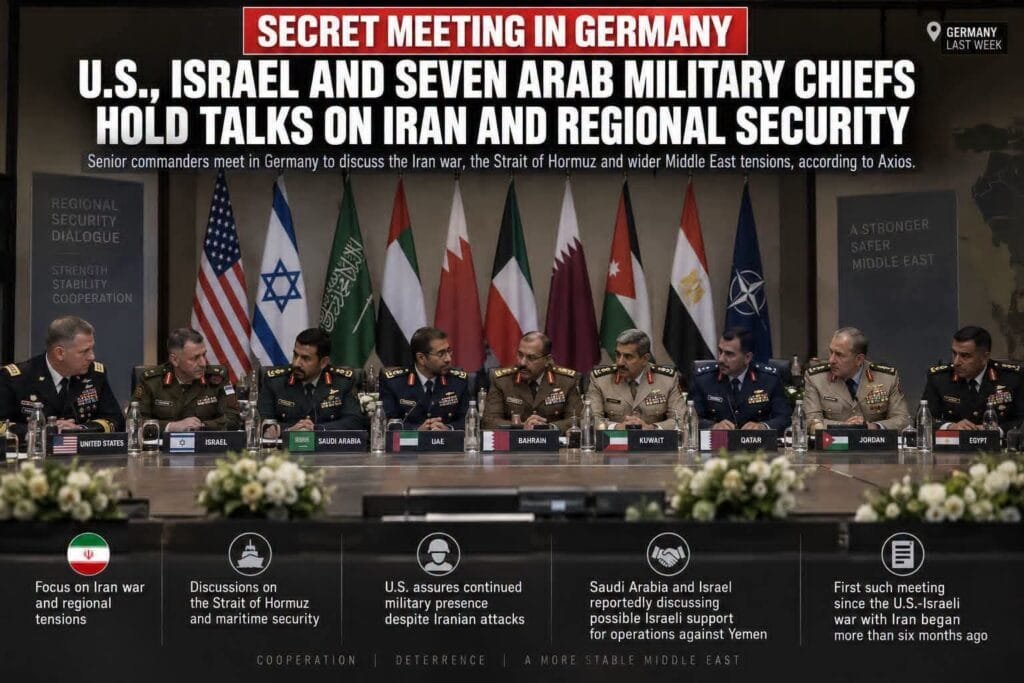
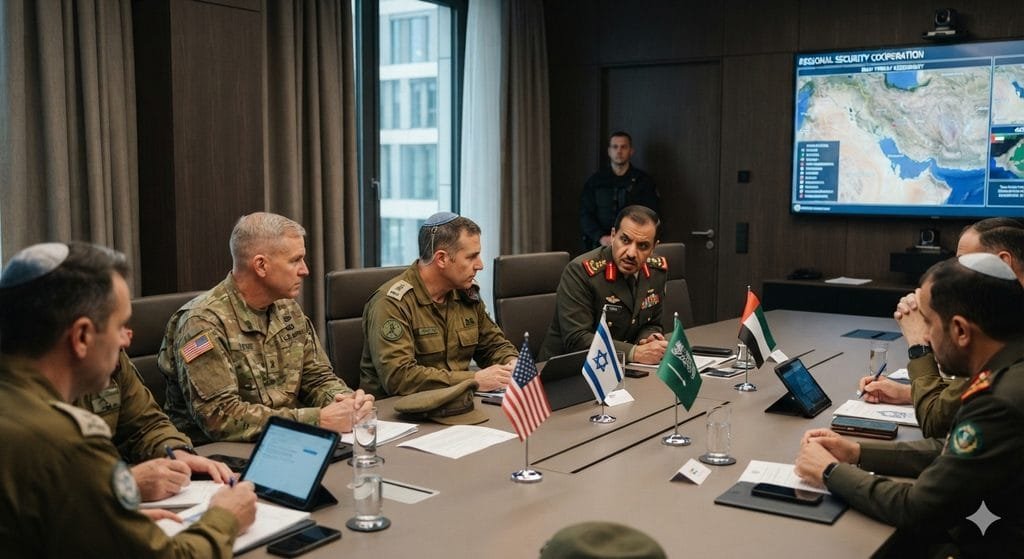
Top military commanders from the United States, Israel, and seven Arab nations convened for a classified meeting in Germany last week to discuss the ongoing war with Iran and broader regional security tensions. The gathering, organized by U.S. Central Command (CENTCOM) chief Adm. Brad Cooper, brought together the military chiefs of Israel, Saudi Arabia, the UAE, Bahrain, Kuwait, Qatar, Jordan, and Egypt.
Notably, the meeting was not publicly announced by any participating government, and it marked the first such assembly since the U.S. and Israel went to war with Iran more than six months ago. CENTCOM later confirmed the meeting in a brief statement, saying it “hosted senior military leaders from eight nations during a scheduled conference in Germany” where leaders “discussed opportunities for enhancing security cooperation in the Middle East”.
*A Watershed in Regional Military Architecture*
This meeting represents far more than a routine strategic conference. It reflects a structural transformation in Middle Eastern security architecture that has been unfolding since the Abraham Accords were signed in 2020. That shift, however, is neither inevitable nor uncontested — and understanding its full implications requires looking beyond the diplomatic language.
*The CENTCOM Integration Framework*
Israel’s formal transfer from U.S. European Command (EUCOM) to CENTCOM’s area of responsibility was a critical enabling step. As the Jewish Policy Center noted, this transition “represented more than a mere bureaucratic change” — it “signaled a realignment of strategic relationships and expectations, opening the door for multinational exercises, operational synergies, and a plethora of future collaborations between Israel and the moderate Arab states, all under US aegis”.
The depth of this integration has matured significantly. What began as capability building and interoperability has evolved into something approaching combined operations. The International Maritime Exercise (IMX) series, hosted by the U.S. Navy’s Fifth Fleet in Bahrain, now features Israeli naval assets operating alongside Gulf Arab partners, covering scenarios from mine countermeasures to unmanned systems integration. Israel’s naval presence in the Arabian Gulf and Red Sea has become “a practical component of regional maritime security,” operating under shared deconfliction and tactical communication frameworks with other CENTCOM partners.
This institutional architecture explains how a meeting of this nature could take place at all — but it does not explain why it happened now. The answer lies in the convergence of an escalating Iran war, Houthi advances in the Red Sea, and shifting U.S. commitments.
*The Multi-Layered Cooperation: From Symbolism to Battlefield Reality*
The most tangible evidence of Israel-Arab military cooperation during the current war is the Israel-UAE defense partnership. Israel deployed the Iron Dome missile defense system in the UAE, along with IDF personnel to operate it — the first such deployment outside Israeli territory and the United States. Israel also provided real-time intelligence, surveillance, and reconnaissance (ISR) support and deployed an Iron Beam laser-based air defense system to the Emirates.
The Israeli-UAE partnership has extended beyond purely defensive operations. According to Israeli officials, the two countries cooperated on both defensive and offensive maneuvers during the war, with intelligence sharing reaching “unprecedented levels”. A U.S. envoy publicly acknowledged that Israel deployed Iron Dome batteries to the UAE, and bilateral relations have “gone beyond diplomatic normalization to include field military cooperation, security intelligence exchanges, and the direct presence of Israeli military infrastructure on the soil of an Arab country”.
The expansion of cooperation to Saudi Arabia, however, represents a more significant strategic shift. A source with knowledge of the matter confirmed that Israel and Saudi Arabia — with CENTCOM’s assistance — are discussing how Israel could support Saudi military operations against the Houthis, potentially modeling the assistance on Israeli ISR support already provided to the UAE. If realized, this would mark an extraordinary development: direct Israeli intelligence support for Saudi combat operations, absent any formal diplomatic relationship.
*The Broader Security Architecture: Institutional Infrastructure*
The Germany meeting did not emerge from a vacuum. It sits atop a growing institutional infrastructure for multilateral security cooperation in the region. CENTCOM and regional partners opened a new air defense operations cell at Al Udeid Air Base in Qatar — the Middle East Air Defense Combined Defense Operations Cell (MEAD-CDOC) — to enhance integrated air and missile defense coordination across the theater. CENTCOM also established a new multinational one-way attack drone task force, “Task Force Falcon Strike,” designed to integrate allied equipment and technology into a unified command-and-control system.
These institutional developments provide the practical framework within which the Israel-Arab military coordination discussed at the Germany meeting could be operationalized. They represent the “plumbing” of regional security cooperation — less visible than high-profile diplomatic summits but arguably more consequential for long-term strategic alignment.
*Iran’s Retaliatory Campaign* :
*The Threat Driving Cooperation*
The urgency behind the Germany meeting is directly tied to the scale of Iranian retaliation. According to a Pentagon Inspector General report — the first official accounting of the war — hundreds of buildings and facilities at U.S. military bases across the region were damaged or destroyed by Iranian attacks between February 28 and June 30, 2026. Iranian strikes targeted U.S. bases in Kuwait, Bahrain, Qatar, the UAE, Saudi Arabia, Iraq, Oman, and Jordan, causing significant modifications to U.S. force deployments and operations. The report noted the destruction of the U.S. naval forces’ regional command headquarters in Bahrain, which complicated the establishment of new naval bases and support ports and led to the transfer of certain logistics operations to Diego Garcia in the Indian Ocean.
This sustained Iranian assault on U.S. positions — with damage across eight countries — underscores the threat environment that brought these military leaders to the table. It also reveals a potential disconnect: the commander of U.S. naval forces in the region lost his headquarters, yet Washington’s message to Arab partners at the Germany meeting was that its commitment remains unwavering. The U.S. has increased its troop presence in the Middle East to approximately 50,000 personnel, up roughly 10,000 from pre-war levels.
*The Houthi Threat:*
*Expanding the Conflict’s Geography*
The meeting took place against the backdrop of a dramatic Houthi military escalation. The Iran-backed group captured a key port city (Mokha) and an island on the Bab el-Mandeb Strait, placing its forces just 32 kilometers from the U.S. military base in Djibouti — the main U.S. base in Africa. The Houthis claimed new missile and drone attacks on Saudi Arabia, including targeting the Khamis Mushait airbase in southern Saudi Arabia.
The Houthi advance threatens one of the world’s most critical maritime chokepoints. The Bab el-Mandeb connects the Red Sea to the Gulf of Aden and is a crucial alternative shipping route when the Strait of Hormuz is disrupted — as it currently is. With the Strait of Hormuz “largely paralysed” six months into the Iran war, commodity carrier traffic has plummeted to an average of 10 transits per day, compared with a daily average of far higher volumes before the conflict. India’s External Affairs Ministry explicitly warned that Houthi strikes “undermine regional stability and threaten freedom of navigation through the Bab el-Mandeb”.
The strategic significance is clear: with one key chokepoint already degraded, the potential loss of the other would compound global energy supply disruptions. For Gulf states, this is not a distant concern but an immediate economic and security threat — explaining why they were willing to sit at the same table as Israel, despite the political sensitivities.
*An Alliance Built on Convenience, Not Consensus*
While the meeting marks a significant milestone, several critical observations must be made:
1. The “Coalition of Convenience” Problem.
The participants came together not out of shared political vision but out of convergent threat perceptions. Several participating Arab states — notably Saudi Arabia, Kuwait, and Qatar — do not have diplomatic relations with Israel. Their attendance reflects a calculated assessment that the immediate Iranian threat and Houthi advances outweigh the political costs of tacit cooperation with Israel. But this pragmatic alignment does not resolve the underlying political disputes. As one analysis noted, “when it comes to security, some of those differences are becoming easier to work around” — which is not the same as resolving them. The question is whether these operational ties can survive a change in threat environment or a shift in domestic political pressures. Historically, security cooperation built on threat convergence rather than shared interests tends to be fragile.
2. America’s Reassurance Amid Credibility Erosion.
Adm. Cooper’s reassurance that the U.S. would not withdraw forces from the region is significant but must be weighed against Iran’s demonstrated ability to inflict damage on U.S. bases across eight countries. The destruction of the U.S. naval command headquarters in Bahrain and the partial relocation of logistics to Diego Garcia suggest that the U.S. military posture in the region is under real strain. Washington’s message of commitment rings hollow when bases are being evacuated and operations relocated. For Arab partners, the question is not simply whether America will stay, but whether it can effectively protect them.
3. The Saudi-Israel Intelligence-
Sharing Model Raises Structural Questions.
The reported plan for Israel to provide ISR support to Saudi operations against the Houthis, modeled on its assistance to the UAE, represents a qualitative shift in the region’s security architecture. But it also raises uncomfortable questions: How will this cooperation be justified publicly in Saudi Arabia, where anti-Israel sentiment remains significant? And what happens if U.S. domestic political dynamics shift and Washington reduces its role as the enabling framework? The model depends heavily on CENTCOM’s continued function as a hub — without it, direct Israeli-Saudi military cooperation would be politically untenable for Riyadh.
4. The U.S.-Israel Strategic Divergence Casts a Shadow.
A less-discussed but critical dimension is the widening gap between U.S. and Israeli strategic objectives in the Iran war. The conflict began in February 2026 with apparent unity behind Operation Epic Fury, but within weeks, analysts identified “palpable discord” between Washington and Jerusalem. Israel continues to pursue what analysts describe as “maximalist objectives,” including targeted killings of senior Iranian figures and strikes on core political assets, while the U.S. has narrowed its goals to degrading Iran’s missile program, nuclear capabilities, and proxy networks.
This divergence has translated into operational frictions. Following Israeli strikes on the South Pars gas field and associated oil and petrochemical facilities, Washington publicly distanced itself from Israeli actions. Trump stated the U.S. had “no prior knowledge” of certain Israeli operations and insisted that future strikes on energy targets would require American approval. Axios called it “the first major diplomatic falling out between the two nations since the start of the conflict,” with a Trump adviser quoted as saying, “The president doesn’t like the attack”.
The divergence extends to endgame calculations. U.S. officials increasingly view full regime change in Iran as potentially triggering regional instability and civil conflict, while Israeli officials “have grown convinced that Trump is much less eager than they are to see full regime change”. From Israel’s perspective, the American shift may appear as “a strategic mistake that could undermine gains achieved on the battlefield”.
This tension is directly relevant to the Germany meeting. Arab participants were ostensibly gathered to coordinate against Iran, but they were doing so under a U.S.-led framework whose strategic coherence is itself in question. If Washington and Jerusalem disagree on fundamental war objectives — from targeting criteria to acceptable escalation levels to the endgame — how can Arab partners be confident in the alliance’s strategic direction?
5. The Asymmetric Dependency Trap.
The cooperation framework rests on a fundamental asymmetry: Israel brings advanced technology (Iron Dome, Iron Beam, ISR capabilities, cyber defense platforms) and battle-tested operational experience, while Arab states bring geography, basing rights, and financial resources. This creates a relationship in which Arab partners become dependent on Israeli and American technology and intelligence — a dependency that may limit their strategic autonomy over time. The deployment of Israeli military personnel to operate Iron Dome systems on UAE soil, while operationally effective, represents a significant sovereign concession that could become politically contentious.
6. Whither the Palestinian Question?
One glaring omission from the meeting’s reported agenda is the Palestinian issue. The Abraham Accords framework was built partly on the premise that Arab states could normalize relations with Israel without requiring progress on Palestinian statehood. But as the war in Gaza continued and the West Bank remained volatile, this premise has come under increasing strain. The cooperation now being deepened under CENTCOM’s umbrella may be militarily effective, but it risks further eroding the political space for a two-state solution — a consequence that could generate instability in the medium to long term.
The Houthi Threat as a Catalyst
A key driver of the deepening cooperation is the Houthi escalation in the Red Sea. The group’s capture of a key port city and effective control of the Bab al-Mandeb Strait has alarmed markets and created a direct threat to Gulf shipping. The Houthis have attacked Saudi Arabia’s East-West oil pipeline, which serves as a critical bypass for Saudi oil exports when the Strait of Hormuz is disrupted. The advance places the Houthis approximately 32 kilometers from the U.S. military base in Djibouti, the main American base in Africa.
These developments explain the urgency behind the reported Israel-Saudi discussions on intelligence support. But they also expose a deeper structural problem: the U.S.-led security architecture in the Middle East is being tested simultaneously on multiple fronts — Iran, the Houthis, and the internal strains of alliance management — while its two most powerful members, the U.S. and Israel, are increasingly at odds over strategy. The Saudi-Israel intelligence-sharing model may be operationally effective in the short term, but it does not address the underlying structural weakness: an alliance system that depends heavily on American military presence and leadership, even as that leadership faces a credibility gap.
Limitations and Cautions
It is important to acknowledge the limitations of the available information. The meeting was disclosed by two Israeli officials to Axios, and details have not been independently verified by all participating governments. Israel’s military declined to comment on the report. The precise agenda, the level of specificity in discussions, and the concrete outcomes remain unclear. The CENTCOM statement confirming the meeting was deliberately vague, referring only to “opportunities for enhancing security cooperation” without naming participants or specific topics.
Moreover, the claim that Israel provided ISR support to the UAE and deployed Iron Dome systems there has been confirmed by multiple sources, including a U.S. envoy and Financial Times reporting, but the full scope and operational details of such support remain classified.
What to Watch
Several developments will determine whether this meeting represents a genuine strategic realignment or a temporary convergence of convenience:
· Whether Israel-Saudi intelligence cooperation against the Houthis materializes — and how it is publicly framed (or concealed) by Riyadh.
· Whether the U.S. can reconcile its strategic divergence with Israel — particularly on targeting criteria and endgame objectives — before it undermines the broader coalition framework.
· Whether additional Arab states join the CENTCOM-facilitated cooperation architecture — potentially including countries like Morocco and others with Abraham Accords ties.
· Whether the Houthi advance triggers a broader regional military response — and whether Israel’s ISR capabilities become a formal part of that response.
· Whether the Strait of Hormuz situation stabilizes — since continued paralysis there will only increase pressure on the Bab el-Mandeb route, which the Houthis now threaten.
· Whether domestic political pressures in Arab participating states — particularly Saudi Arabia and Jordan — constrain their ability to deepen visible security cooperation with Israel.
The Germany meeting represents a significant moment in Middle Eastern security affairs — one that reflects real convergence of threat perceptions and institutional deepening of military cooperation. The integration of Israel into CENTCOM’s regional architecture, combined with the operational pressures of the Iran war and the Houthi threat, has created conditions in which erstwhile adversaries can cooperate militarily.
But this cooperation rests on fragile foundations. The political differences between Israel and its Arab partners remain unresolved. American military credibility in the region is under strain. The U.S.-Israel alliance itself faces growing strategic divergence over the fundamental direction of the Iran war. And the cooperation framework remains dependent on CENTCOM’s continued function as an enabling hub. Whether this represents the foundation of a durable regional security order — or merely a temporary alignment of convenience that will fracture once the immediate threat recedes — remains the central question that the participants in that German conference room did not address, and perhaps could not.