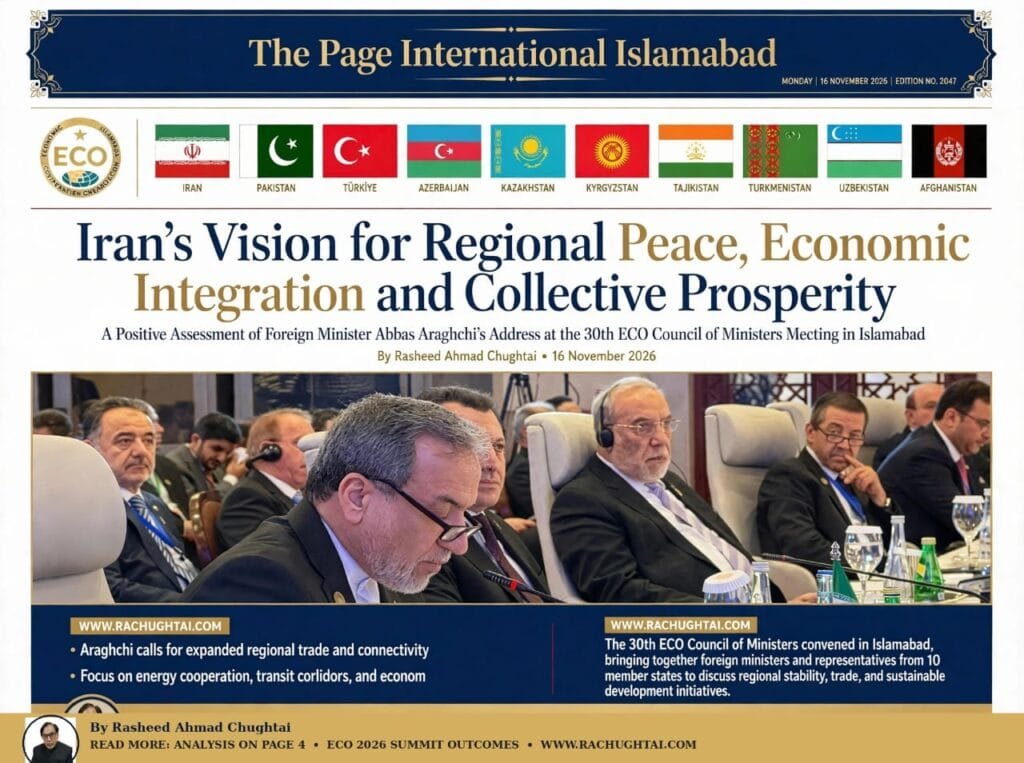
Iran’s Vision for Regional Peace, Economic Integration and Collective Prosperity
A Positive Assessment of Foreign Minister Abbas Araghchi’s Address at the 30th ECO Council of Ministers Meeting in Islamabad.
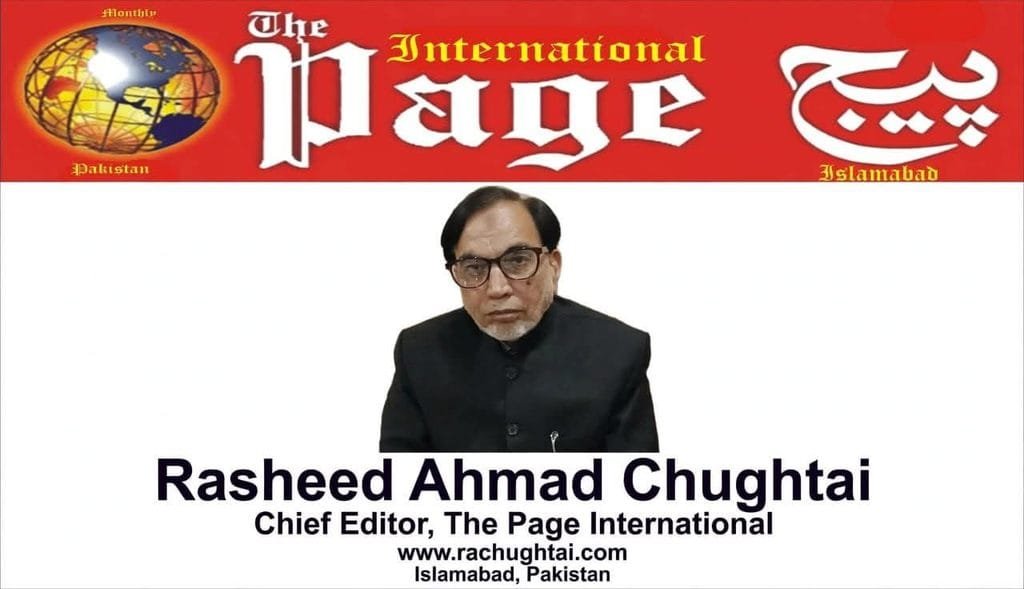
*By Rasheed Ahmad Chughtai**
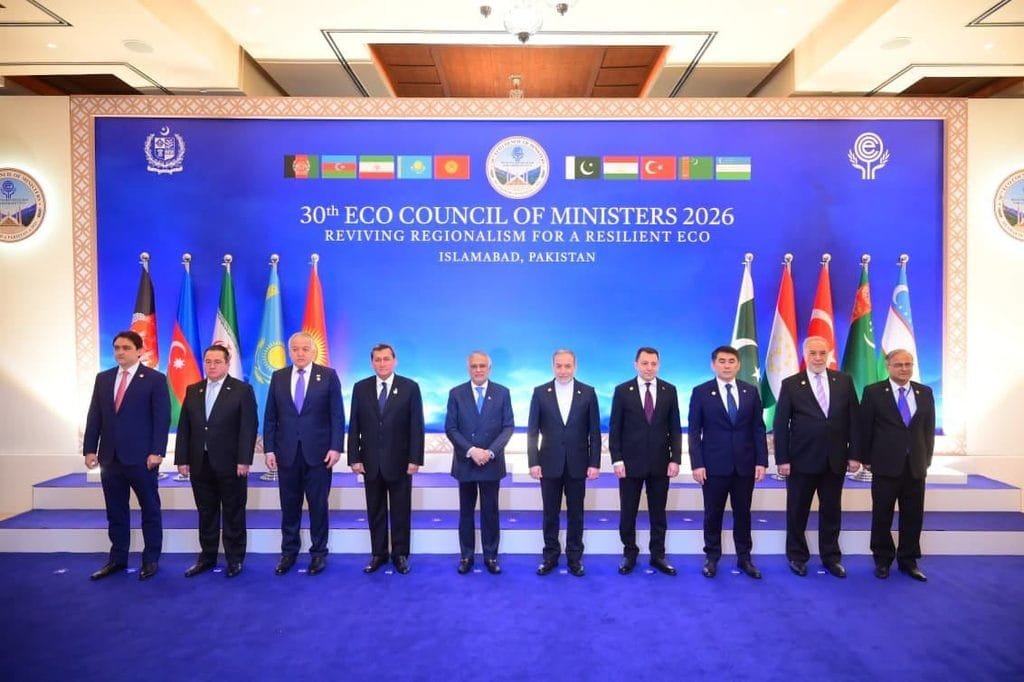
The address delivered by H.E. Dr. Seyed Abbas Araghchi, Foreign Minister of the Islamic Republic of Iran, at the 30th Meeting of the Council of Ministers of the Economic Cooperation Organization (ECO), held in Islamabad on 16 November 2026, represents an important diplomatic contribution to the evolving regional and international discourse. His statement reflects Iran’s commitment to regional cooperation, economic integration, respect for national sovereignty, peaceful diplomacy and the pursuit of a more balanced and equitable international order.
At a time when the Middle East and the wider region are experiencing serious geopolitical challenges, economic uncertainties and security tensions, Iran’s emphasis on dialogue, regional solidarity and collective development deserves serious consideration.
Iran’s Constructive Vision for Regional Cooperation
One of the most significant aspects of Dr. Araghchi’s address is his emphasis on transforming ECO into a more effective platform for practical cooperation among its member states.
His identification of **trade, transport and energy as the three strategic pillars of regional cooperation** offers a realistic and forward-looking framework for economic development.
Iran possesses considerable geographical, industrial, energy and infrastructural potential. Its strategic location connecting Central Asia, South Asia, the Caucasus and the Middle East gives it an important position in regional connectivity.
Strengthening economic relations among ECO member countries can open new opportunities for investment, transportation, trade corridors, energy partnerships and industrial development. Such cooperation would benefit not only Iran but also Pakistan, Türkiye, Azerbaijan, Kazakhstan, Uzbekistan, Afghanistan and other participating countries.
Iran’s support for reforming the ECO Trade Agreement (ECOTA) is particularly encouraging. A modern, inclusive and effective regional trade framework could reduce economic barriers, encourage investment and promote greater commercial interdependence.
Iran’s Sovereignty and the Principle of International Law
A central message of Dr. Araghchi’s speech concerns the importance of national sovereignty, territorial integrity and the peaceful settlement of international disputes.
Iran has consistently presented its position on the importance of diplomacy, the United Nations Charter and the rejection of military aggression. The Foreign Minister’s address also expressed serious concerns regarding the consequences of military confrontation, economic sanctions and external interference.
From a regional perspective, the principle that the territory, airspace and military facilities of neighbouring countries should not be used to launch attacks against another regional state is an important proposition.
This principle should be respected universally. Every country has the legitimate right to sovereignty, security and territorial integrity. Equally, all states have a responsibility to respect the sovereignty of their neighbours and avoid actions that could expand conflict.
The way forward must be based on mutual respect, restraint, diplomatic engagement and internationally recognised legal principles.
Regional Security Must Be Owned by Regional Countries
Perhaps one of the most constructive proposals in the Iranian Foreign Minister’s address is the call for an inclusive, regionally owned security framework.
The security of the Persian Gulf, the Strait of Hormuz and the wider Middle East cannot be separated from the interests of the countries situated in this strategically important region.
Regional peace should not depend exclusively on external military arrangements or competing geopolitical interests. The countries of the region must develop mechanisms for consultation, confidence-building, non-aggression and peaceful conflict resolution.
Iran’s proposal for dialogue among neighbouring countries deserves serious diplomatic engagement.
A sustainable regional security arrangement should guarantee the independence, territorial integrity and legitimate security concerns of every participating state. It should also prevent the region from becoming an arena for rivalries between global powers.
Such an approach could establish a foundation for lasting peace and mutual confidence.
Energy Cooperation: An Opportunity for Shared Prosperity
Iran’s emphasis on regional energy cooperation is another important element of the address.
Energy security is directly connected with economic stability, industrial growth and national development. The Persian Gulf and surrounding energy routes are vital to international markets and the economic interests of numerous countries.
Instead of allowing geopolitical competition to disrupt energy supplies and commercial activities, regional states should explore joint energy projects, electricity connectivity, infrastructure development and reliable mechanisms for energy transportation.
Iran’s energy potential, combined with the requirements of Pakistan and other ECO countries, creates opportunities for mutually beneficial cooperation.
A peaceful and economically integrated region would provide greater energy security, reduce external vulnerabilities and strengthen the collective resilience of participating economies.
Iran and Pakistan: An Important Partnership for Regional Stability
For Pakistan, Dr. Araghchi’s address carries particular diplomatic and economic significance.
Pakistan and Iran share geographical proximity, historical connections, cultural relations, religious bonds and important common regional interests. Both countries have considerable opportunities to strengthen bilateral trade, border cooperation, transportation, energy relations and people-to-people contacts.
Pakistan can play a constructive role in encouraging dialogue, reducing regional tensions and strengthening communication among neighbouring countries.
The development of Pakistan-Iran economic relations should be viewed as an opportunity for regional progress rather than through the narrow perspective of geopolitical competition.
Enhanced connectivity between Pakistan, Iran and Central Asian states could create new trade routes and commercial opportunities. It could also strengthen Pakistan’s position as an important gateway connecting South Asia with the Middle East and Central Asia.
The future requires greater diplomatic coordination, mutual confidence and practical economic initiatives between Islamabad and Tehran.
Iran’s Position on Palestine: A Call for Humanitarian Responsibility
Another important dimension of the Iranian Foreign Minister’s address was his strong emphasis on Palestine, particularly the humanitarian catastrophe in Gaza and the continuing difficulties faced by Palestinians in the occupied West Bank and Al-Quds.
His appeal for unrestricted humanitarian assistance, including food, medicines, temporary shelter and reconstruction materials, reflects an urgent humanitarian concern.
The suffering of Palestinian civilians must remain a priority for the international community. The protection of innocent lives, respect for international humanitarian law, access to humanitarian assistance and the fundamental rights of the Palestinian people should not be subjected to political considerations.
Iran’s continued advocacy for Palestine places the Palestinian question within the broader framework of human dignity, justice and international responsibility.
The international community must pursue a just and sustainable resolution that protects the rights and security of all civilians and addresses the legitimate aspirations of the Palestinian people.
The Emerging International Order and Iran’s Regional Role
The contemporary international system is undergoing significant transformation. Traditional geopolitical arrangements are being challenged by emerging economic powers, changing alliances, regional partnerships and new centres of influence.
In this changing environment, Iran’s emphasis on a more equitable and inclusive international order reflects an important debate about the future of global governance.
Countries of Asia, the Middle East and Central Asia increasingly recognise the importance of strengthening their economic independence, regional institutions and diplomatic partnerships.
ECO can become an effective instrument for this transformation if its members move beyond declarations and translate their commitments into practical projects.
The forthcoming 18th ECO Summit in Tehran on 4 December 2026 provides an opportunity to advance this vision and establish measurable objectives for regional cooperation.
Iran’s Diplomatic Message and Regional Opportunities
From a broader geopolitical perspective, Dr. Araghchi’s address conveys five important messages:
**First: Diplomacy over confrontation.** Iran’s emphasis on dialogue and peaceful settlement offers a diplomatic framework for reducing tensions and preventing further regional instability.
**Second: Regional ownership of security.** Neighbouring countries should have a leading role in determining their security arrangements through consultation, non-aggression and mutual respect.
**Third: Economic integration over geopolitical isolation.** Trade, energy and transportation can become instruments of peace, stability and shared development.
**Fourth: Respect for sovereignty and international law.** The territorial integrity and independence of every state must be protected through consistent application of international legal principles.
**Fifth: Humanitarian solidarity and justice.** The international community must respond to humanitarian suffering, particularly in Palestine, with practical measures and a commitment to protecting civilian lives.
These priorities provide an important basis for constructive engagement with Iran and other regional countries.
A Hope for Peace, Stability and a Prosperous Region
Iran is an important regional country with significant historical, cultural, geographical, economic and strategic potential. Its stability and prosperity are closely connected with the stability and prosperity of its neighbours.
The message delivered by Foreign Minister Abbas Araghchi in Islamabad should be viewed as an opportunity to strengthen regional dialogue, expand economic cooperation and promote a more peaceful and interconnected future.
Pakistan, Iran and other ECO member states have a shared responsibility to transform geographical proximity and historical relations into practical partnerships.
The region does not need further confrontation, mistrust or destructive geopolitical competition. It needs economic opportunities, educational advancement, scientific cooperation, energy security, humanitarian solidarity and diplomatic understanding.
**Peace cannot be achieved through confrontation alone; it requires mutual respect, dialogue, justice and collective responsibility.**
It is our sincere hope that Iran and all neighbouring countries will move towards a new era of peace, stability, friendship and economic progress. May the ECO platform become a meaningful bridge connecting nations, strengthening regional solidarity and improving the lives of millions of people.
**A peaceful, prosperous and united region is not merely a diplomatic aspiration; it is a shared responsibility and a necessity for future generations.**
*Rasheed Ahmad Chughtai*
Islamabad, Pakistan
Chief Editor – The Page International
www.rachughtai.com