
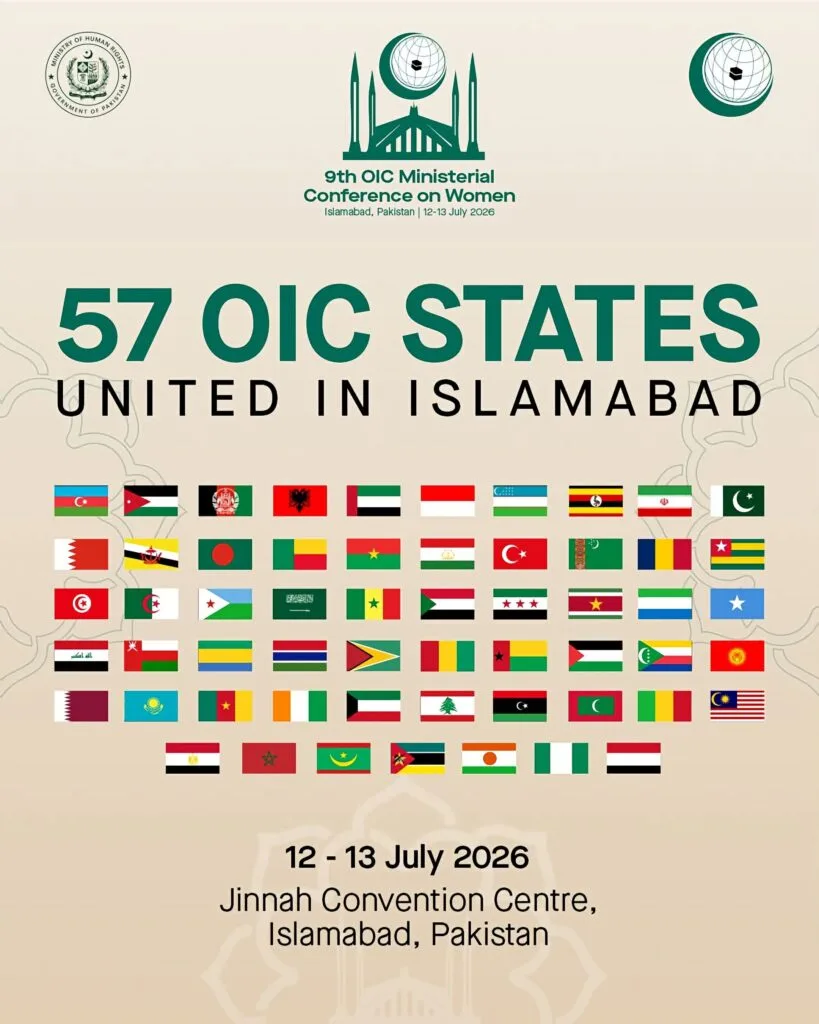
OIC 9th conference in Islamabad on
Socio-Economic and Political Empowerment of Women in OIC Countries: Challenges and the Way Forward
Rasheed Ahmad Chughtai
Email
thepageintl.pk@gmail.com
Introduction
The Organization of Islamic Cooperation (OIC), representing 57 member states across four continents, stands as the second-largest intergovernmental organization after the United Nations. With the female population in OIC member states estimated to exceed one billion by 2025—accounting for 49.4% of the total OIC population and 25.8% of the world’s female population—the empowerment of women in these countries is not merely a matter of social justice but a demographic and economic imperative of global significance.
Yet, a persistent narrative—both within and outside these societies—points to significant gaps between the rights Islam confers upon women and the realities they face in many OIC countries. This article examines the socio-economic and political empowerment of women in OIC member states, analyzes the challenges rooted in constitutional, legal, and cultural frameworks, and proposes a way forward grounded in both Islamic principles and international human rights standards.
Preamble
In the year 632 CE, on the plains of Mount Arafat, the Prophet Muhammad (PBUH) delivered his historic Farewell Sermon—a universal declaration of human rights and divine accountability that would echo through the ages; amidst the verses of finality, he issued a clarion call: “Fear Allah concerning women. Verily you have taken them on the security of Allah and have made their private parts lawful unto you by the words of Allah.” This was not a mere plea for kindness but a binding covenant, elevating women from the status of pre-Islamic chattel to that of independent spiritual and legal entities, commanding the nascent Muslim community to honor their dignity as a sacred trust. Yet over fourteen centuries later, as the fifty-seven member states of the Organization of Islamic Cooperation prepare for the ninth Ministerial Conference on Women in Islamabad in July of 2026, they confront a profound and unsettling paradox: the same religion that abolished female infanticide, granted women the explicit right to inherit, own property, initiate divorce, and pursue education, now presides over a bloc where women account for nearly one billion two hundred million souls—nearly half the entire Ummah—yet remain the most marginalized demographic in global socio-economic and political indices. The statistics are not mere numbers but the quantified voices of silenced generations; according to recent OIC-2025 Programme of Action benchmarks, while female literacy has seen incremental gains, the average female labor force participation rate in OIC countries languishes at approximately twenty-five to thirty percent, drastically below the global average of forty-seven percent, and in the political arena, several member states—including Oman and Yemen—maintain parliaments with zero female representation, while those with women rarely exceed fifteen to twenty percent of legislative bodies, placing the OIC far below the global average of twenty-six point five percent for women in national parliaments. This is not a Western issue but a developmental, economic, and moral crisis; the World Bank estimates that closing the gender gap in labor participation could boost the GDP of Middle Eastern and North African OIC states by over thirty-five percent, and when the Ummah silences half its intellectual capital, it does not merely violate human rights but starves its economies, weakens its social fabric, and betrays the very Maqasid al-Shariah—the higher objectives of Islamic law which prioritize the preservation of intellect, lineage, and dignity. It is an intellectual disservice to conflate the timeless revelations of the Quran with the temporal, patriarchal cultural practices that have metastasized across many OIC states; the Cairo Declaration on Human Rights in Islam enshrines the protection of women’s dignity, and the OIC’s Independent Permanent Human Rights Commission repeatedly affirms that “Islam rejects violence in all its forms,” yet as scholars like Fatima Mernissi and Amina Wadud have extensively argued, the historical codification of Islamic jurisprudence often reflected the socio-political constraints of the Abbasid and Umayyad eras rather than the egalitarian spirit of Medina under the Prophet. The gap, therefore, is not between Islam and the United Nations Charter but between divine revelation and human implementation; the UN’s Sustainable Development Goal Five aligns seamlessly with the Quranic proclamation in Surah Al-Hujurat: “O mankind, indeed We have created you from male and female and made you peoples and tribes that you may know one another. Indeed, the most noble of you in the sight of Allah is the most righteous of you”—where righteousness, not gender, determines honor. The constitutional deficit remains glaring, for while many states invoke the supremacy of Sharia in their preambles, they concurrently implement restrictive interpretations that curtail women’s marital autonomy, guardianship rights, and freedom of movement, with reservations attached to the Convention on the Elimination of All Forms of Discrimination against Women serving as the legal embodiment of this schizophrenia—accepting international standards in principle while fundamentally undermining them in practice through vague clauses such as “in accordance with Islamic law.” This selective interpretation is the Achilles’ heel of the OIC, as Mahya Saffarinia of Imam Sadiq University emphasizes in her 2025 study, for the organization operates almost exclusively within a soft-law framework—producing declarations without enforcement and planning action without accountability—allowing states to sign global compacts while domestically enforcing guardianship laws that require a male relative’s permission for a woman to travel, work, or marry, effectively treating an adult Muslim woman as a perpetual minor in civil jurisprudence. Yet the ninth OIC Ministerial Conference on Women, scheduled for July twelfth and thirteenth in Islamabad, stands as a pivotal inflection point, aiming to “develop a synthesis to create an enabling environment for women in the OIC-member countries where they can fully realize their potential”—a promise that the world, and the one point two billion women watching, demand not as a concession to Western liberalism but as an authentic, non-negotiable pillar of orthodox Islamic revival. This examination endeavors to dissect the intricate web of socio-economic and political disenfranchisement facing women in OIC states, navigating the contradictory landscape of Islamic legal theory versus practiced cultural patriarchy, dissecting constitutional gaps that perpetuate systemic inequality, and critically analyzing scholarly recommendations to bridge the chasm between universal human rights and Islam’s divine justice; for the way forward lies not in importing foreign cultural norms wholesale nor in retreating into a defensive, fossilized interpretation of faith, but in a robust, contemporary Ijtihad—a jurisprudential renaissance that empowers states to craft laws fiercely Islamic in their essence and universally human in their application, remembering always that the Quran does not require reform, but that the hearts of rulers, interpreters, and implementers most certainly do, and this preamble serves as a testament to that urgent, unfulfilled covenant awaiting redemption in the halls of Islamabad and beyond.
Part I: Islamic Foundations of Women’s Rights—A Clarification
The Quranic Vision of Equality and Dignity
Contrary to popular misconceptions that associate Islam with the subjugation of women, Islamic teachings from the 7th century introduced progressive rights for women that were revolutionary for their time. At a period when female children were buried alive in Arabia and women were treated as transferable property, Islam elevated women to a status of dignity and conferred upon them unprecedented rights.
The Quran establishes the fundamental equality of men and women in the sight of God. As declared in Surah Al-Hujurat (49:13): “Indeed, the most noble of you in the sight of Allah is the most righteous of you”. Similarly, Surah Al-Nahl (16:97) affirms: “To whoever, male or female, does good deeds and has faith, We shall give a good life and reward them according to the best of their actions”.
Academic scholarship on this subject reinforces this understanding. A study published in the Quran and Contemporary Studies journal identifies three overarching themes in the Islamic foundations of women’s empowerment: ontological, anthropological, and axiological. The research demonstrates that the Quranic perspective challenges demeaning views that regard women as secondary or inferior, affirming instead the “equal will and freedom of choice” for both genders and “equality in the purpose of creation”.
Rights Conferred by Islam
Islam granted women rights that Western societies would only recognize centuries later. These include:
· The right to education—seeking knowledge is obligatory for every Muslim, male and female
· The right to choose a marriage partner and to retain identity after marriage
· The right to divorce and to seek legal protection
· The right to work, own property, and conduct business
· The right to vote and participate in civic and political engagement
The Cairo Declaration on Human Rights in Islam reinforces the principle of safeguarding and protecting the dignity of women. The OIC’s Independent Permanent Human Rights Commission (IPHRC) has firmly stated that “women’s rights are fundamental human rights,” rooted in Islamic principles that emphasize “dignity, respect, and justice for all”.
The Gap Between Islamic Teachings and Practice
The critical observation, however, is that while Islam provides the normative framework for women’s empowerment, cultural practices, patriarchal interpretations, and inadequate legal implementation have created a significant gap between Islamic ideals and the lived realities of women in many OIC countries. As scholars have noted, “Muslims are not always representative of the Islamic tradition”—cultural practices often conflated with religion have frequently undermined the rights Islam guarantees.
Part II: The Current State of Women’s Empowerment in OIC Countries
Socio-Economic Challenges
Education: Despite progress, girls in many OIC countries continue to face structural and cultural barriers to education. The OIC’s recognition of this challenge is evident in the Islamabad Declaration on Girls’ Education (January 2025), which called for providing educational opportunities for girls in Muslim communities and developing supportive policies. However, implementation remains inconsistent across member states.
Economic Participation: While the OIC has demonstrated commitment to promoting women’s economic participation, leadership, and protection against gender-based challenges, women across many OIC countries continue to face significant barriers to workforce participation, equal pay, and entrepreneurship opportunities.
Violence Against Women: The OIC’s IPHRC has repeatedly called for intensified efforts to combat all forms of violence against women and girls. The Commission has noted that “Islam rejects violence in all its forms”. In 2025, the OIC highlighted the alarming rise of online violence—including harassment, cyber-stalking, threats, extortion, and AI-enabled impersonation—increasingly targeting women and girls.
Political Participation: A Record of Exclusion
The data on women’s political participation in OIC countries presents a sobering picture. In 2025, several OIC member states still have no women in their parliaments, including Oman and Yemen. The Maldives has only 2–3 percent women parliamentarians.
While some progress has been made—the share of women MPs in some countries has risen from 8.8% in 1995 to 39.1% in 2025—this progress is uneven and largely confined to non-OIC countries. Within the OIC bloc, women’s political representation remains significantly below global averages.
The 19th Conference of the Parliamentary Union of the OIC Member States (PUIC), held in Jakarta in May 2025, advocated for greater opportunities for women to participate in public decision-making processes. Yet advocacy has not translated into uniform constitutional guarantees across member states.
Constitutional and Legal Frameworks: The Implementation Deficit
Many OIC member states have constitutional provisions that ostensibly guarantee women’s rights. Country presentations at OIC forums have highlighted “constitutional guarantees, legislative and policy frameworks” within each member state. However, significant gaps persist between constitutional promises and actual implementation.
A 2025 study examining international legal mechanisms for advancing women’s rights in Islamic states identified several critical challenges: “reservations to international treaties, weak enforcement mechanisms, and socio-cultural barriers that limit women’s full legal autonomy”. These barriers are not merely legal but deeply embedded in social structures and interpretations of religious law.
Part III: Scholarly Analysis of the OIC’s Role
The Soft-Law Framework Problem
A comprehensive study by Mahya Saffarinia of Imam Sadiq University in Tehran, examining OIC documents up to 2024, provides critical insights into the organization’s effectiveness in advancing women’s status. The research finds that while “OIC activities in the field of women have shown increased quantitative and qualitative momentum, they largely operate within a soft-law framework lacking binding conventions and effective enforcement mechanisms”.
This is a fundamental limitation. Without binding conventions and enforceable mechanisms, OIC declarations and plans of action remain aspirational rather than transformative. The study further concludes that “internal divergences across OIC institutions and member states, coupled with external pressures, have so far prevented the emergence of a coherent or influential model for women’s rights promotion”.
Symbolic vs. Substantive Commitment
Research by Sandra Pertek, published in the Politics and Religion Journal (2025), critically analyzes the OIC’s role in assisting women in conflict and displacement. The findings indicate that “although the OIC has articulated political commitments and introduced institutional measures in collaboration with international organisations such as the UN, its contribution remains largely symbolic due to the absence of a coordinated refugee support mechanism within its ecosystem”.
Pertek notes that the OIC’s “soft, non-binding commitments offer ethical and moral value, rooted in Islamic principles, to enhance support for displaced women”. However, ethical value alone does not translate into protection on the ground.
The Way Forward: From Soft Law to Hard Commitments
Both studies converge on a critical recommendation: the OIC must move beyond soft-law frameworks toward binding conventions with effective enforcement mechanisms. As Saffarinia argues, the OIC has “yet to establish a significant normative or operational presence either within its member states or on the broader transregional stage”. This must change if women’s empowerment is to become a reality rather than a rhetorical commitment.
Part IV: The Way Forward—Recommendations for Action
1. Constitutional Protection and Legal Reform
OIC member states must ensure that their constitutions explicitly guarantee women’s full and equal rights in all spheres of life—political, economic, social, and cultural. Constitutional provisions must be backed by enforceable legislation and independent judicial mechanisms.
Specific actions:
· Remove all reservations to CEDAW (Convention on the Elimination of All Forms of Discrimination against Women) and align national laws with international human rights standards
· Establish constitutional courts or human rights commissions with the authority to hear and adjudicate gender discrimination cases
· Reform family laws to ensure they reflect Islamic principles of justice and equality rather than patriarchal cultural interpretations
2. Equal Opportunities in Education and Employment
Education:
· Implement and enforce compulsory primary and secondary education for girls in all OIC member states
· Allocate adequate resources for girls’ education, as emphasized by the OIC Secretary-General
· Remove structural and cultural barriers that limit girls’ access to education
Employment:
· Enact and enforce laws guaranteeing equal pay for equal work
· Remove legal barriers to women’s employment in all sectors
· Provide maternity protection, childcare facilities, and workplace flexibility
· Promote women’s entrepreneurship through access to credit, training, and mentorship
3. Zero Tolerance for Harassment and Violence
The OIC’s IPHRC has correctly identified violence against women as a fundamental violation of human dignity. Member states must:
· Criminalize all forms of violence against women, including domestic violence, sexual harassment, and online abuse
· Establish accessible reporting mechanisms and support services for survivors
· Address digital violence, which the OIC has identified as an “alarming rise” threatening women’s safety and participation
· Implement the goals outlined in the OIC-2025 Programme of Action to combat and eliminate violence against women
4. Political Participation and Leadership
OIC countries must take concrete steps to increase women’s political participation:
· Introduce quotas or affirmative action measures for women in parliaments and local governments
· Support women’s political leadership through training, mentorship, and funding
· Remove cultural and structural barriers to women’s political participation
· Implement the PUIC’s call for greater women’s involvement in public decision-making
5. Aligning with International Standards While Respecting Islamic Values
The OIC and its member states must recognize that there is no inherent contradiction between Islamic principles and international human rights standards. As the OIC’s MoU with UN Women (signed March 2025) demonstrates, both organizations share “a shared vision of empowering women in all aspects of life”.
The OIC must:
· Develop binding conventions on women’s rights that are grounded in Islamic jurisprudence but meet international standards
· Strengthen the Women Development Organization (WDO) headquartered in Cairo
· Ensure that OIC initiatives evolve into a “particularist and transregional model” that is both authentically Islamic and globally credible
Part V: The 9th OIC Ministerial Conference on Women—A Pivotal Moment
Pakistan is hosting the 9th OIC Ministerial Conference on Women in Islamabad on July 12–13, 2026. This conference will bring together all 57 OIC member states with approximately 190 delegates, including prominent women personalities, government dignitaries, and OIC officials.
Conference Objectives
The conference is aimed at “developing a synthesis to create an enabling environment for women in the OIC-member countries where they can fully realize their potential to contribute to socio-economic development”. It will deliberate on:
· Enhancing the political and professional participation of women
· Advancing women’s access to economic resources and financial systems
· Bridging gender gaps in technology and digital participation
Why This Conference Matters
The Islamabad conference represents a critical opportunity to move beyond rhetoric to action. As the OIC has acknowledged, “women’s empowerment is fundamental to the OIC Charter, the OIC-2025 Programme of Action, the OIC-2035 Programme of Action, and the OIC Plan of Action for the Advancement of Women (OPAAW)”.
However, as scholarly analysis has demonstrated, the gap between OIC commitments and implementation remains vast. The Islamabad conference must therefore focus not merely on declarations but on concrete, measurable commitments with enforcement mechanisms.
Expectations and Hopes
This conference is expected to:
1. Adopt binding resolutions rather than non-binding recommendations
2. Establish accountability mechanisms with regular reporting requirements
3. Allocate adequate resources for implementation at national levels
4. Create a monitoring framework with clear indicators and timelines
5. Strengthen the WDO’s mandate and provide it with enforcement authority
The empowerment of women in OIC countries is not a Western import but a return to Islamic principles of justice, dignity, and equality. Islam granted women rights over 1,400 years ago that many societies have only recently recognized. The challenge is not Islamic teachings but the gap between those teachings and their implementation.
The OIC has made commendable progress in recent years—establishing the Women Development Organization, signing MoUs with UN Women, convening conferences on girls’ education, and repeatedly affirming its commitment to women’s rights. Yet, as scholars have demonstrated, these efforts remain largely within a “soft-law framework lacking binding conventions and effective enforcement mechanisms”.
The 9th OIC Ministerial Conference on Women in Islamabad offers a historic opportunity to bridge this gap. It must move beyond symbolic commitments to establish binding conventions, enforcement mechanisms, and accountability structures that translate Islamic principles into lived realities for over one billion women across the Muslim world.
As the Quran reminds us: “Indeed, Allah does not change the condition of a people until they change what is in themselves” (13:11). The change must begin with the political will of OIC member states to honor the rights Islam has already conferred upon women—and to ensure that those rights are not merely written in sacred texts but realized in constitutions, laws, and the daily lives of women across the OIC countries.
References
1. Saffarinia, M. (2025). Recent Measures of the Organisation of Islamic Cooperation in Developing Women’s Status. International Studies Journal, Imam Sadiq University, Tehran.
2. Pertek, S. (2025). Navigating Displaced Women’s Protection in the Muslim World: Analysis of the Organization of Islamic Cooperation. Politics and Religion Journal, 2025(1), 107-137.
3. Analysis of the Islamic Foundations of Women’s Empowerment in the Quran and Hadith: A Critical Examination of Competing Approaches. Quran and Contemporary Studies, 2025.
4. WhyIslam.org. (2025). Women in Islam: Status, Rights, and Empowerment.
5. OIC and UN Women. (2025). Memorandum of Understanding to Advance Women’s Empowerment. Signed March 20, 2025, UN Headquarters, New York.
6. OIC Independent Permanent Human Rights Commission. (2025). Statements on International Women’s Day and Elimination of Violence against Women.
7. OIC Plan of Action for the Advancement of Women (OPAAW). (2025).
8. OIC-2025 Programme of Action. Goals to Combat Violence against Women and Trafficking.
9. International Legal Mechanisms for Advancing Women’s Rights in Islamic States: The Role of Global and Regional Institutions. (2025).
10. OIC Ministerial Conference on Women. (2026). 9th Session, Islamabad, July 12-13, 2026